Monday, July 12, 2010


Friday, July 2, 2010
A Book Perfect for Harron, Campion or Pierce
I know, this is a film blog, but it's my film blog and I'm going to do what I want with it and I adore Joyce Carol Oates and it's rare that a piece of art moves me the way that this book did, so here it is.
Besides, I think in the right hands this would make a wonderful film. I've often wondered why there haven't been more adaptations of Oates' work.
Incidentally, there's a Facebook group dedicated to lobbying to get Joyce Carol Oates a much deserved Nobel Prize in Literature. Pop over. The more members the better.
"The Tattooed Girl" byJoy ce Carol Oates is quite simply a horrifying, heartbreaking, devastating, hey let's go to the thesaurus and pick out a few more apt adjectives, story.
Besides, I think in the right hands this would make a wonderful film. I've often wondered why there haven't been more adaptations of Oates' work.
Incidentally, there's a Facebook group dedicated to lobbying to get Joyce Carol Oates a much deserved Nobel Prize in Literature. Pop over. The more members the better.
"The Tattooed Girl" by

It actually recalls the underhanded sadism that was in "Where Are You Going, Where Have You Been," which just so happened to be my introduction to Oates.
This story will in turns surprise, repulse and touch you.
Early in the book, we are introduced to a character, Dmitri the waiter, who doesn’t seem like a bad guy in the first few paragraphs, and then, as Oates methodically peels back his layers, we are shocked to find that he is a simple sociopath.
His brutality is truly sickening and through his character, Oates manages to do the impossible.
As I was reading one passage, I felt ashamed of myself.
Not because I had done anything even close to that, but because I was a man.
Or rather because I was human.
 The characters in this book are more than dysfunctional; they are simply broken.
It’s odd but strangely touching how two people, so damaged they could hardly pass for functional, develop this kind of affection, friendship, love and then complete dependency.
This book is filled with surprises and I’m not talking about show-offy twists in the vein of Shyamalan or Palahniuk. (Although for the record, I do think Palahniuk is the exception to the rule as far as dramatic surprises go. He is one of the few that can pull it off and make it feel organic.)
Oates amazes us with how quickly the hatred of her characters can turn to love and vice-versa.
She offers insight into why some people love monsters unconditionally.
 Another surprise is the tender romance that blossoms between
What sets Oates apart is that most writers feel a need to define their characters whereas Oates realizes that this is not always possible since most people don’t know who they are themselves.
This is an incredible, devastating novel and seriously, whether you’ve read Oates or not, whether you’ve liked her before or not, give this one a shot because not only does Oates understand the craft of writing better than most writers, she understand what it means to be human more than most people.
That sounds cliche and pretentious at the same time, but it's true.
And, (I used to be in the habit of tagging out blogs this way. I'm not sure why I stopped. It's a good note to leave things on.) in case y
ou care, I'm listening to a beautiful new 180g re-issue of:

Thursday, June 3, 2010
Kansas City filmmaker screens new film - NBCActionNews.com
 “Numb” is the fifth in a series of short, experimental horror films from Kansas City filmmaker John Barnes. It’s the final chapter of the first volume of the “OV” film series. “Numb” is based on a man who has lost all emotion. He has a beautiful wife and child, but has no feelings and will go to any length just to experience an emotional sensation again.
The short film screened June 2 after the IFC meeting at the Westport Coffee House Theater at 4010 Pennsylvania in Westport. “Numb” will be followed by a screening of filmmaker Jerry White’s “0:22:43.”
John Barnes is a Kansas City native who has been making independent films since 2000. He says the pool of talent in Kansas City is surprisingly endless and sadly untapped.
And when it came to making his dark shorts, the network of filmmakers he has come to rely on is essential. That’s why he has called his production company “Drei Productions.” “Drei” meaning “three” in German. “’Drei Productions’ because it always takes more than one person,” Barnes explains. “You gotta have three or more people to make a short film.”
When I asked him what to expect from the screening of “Numb,” John said, “It’s very dark. It’s based on people that have hidden emotions that come out in extreme, most of the time violent ways.”
Watching "Numb" reminded how good of an artist John was in high school. His eye is brilliant.
After the screening at the IFC meeting, it’s off to other film festivals. There’s the KC Fringe Festival that runs July 23rd through August 1st. The Fringe Fest features art from different mediums and is new to hosting films.
Tuesday, May 18, 2010
9 – Shane Acker (2009)
First, what this movie has going for it. It has atmosphere oozing out its eyeballs. The look and tone of the film is wonderful. Every frame, every shadow has this wonderful texture to it.

I think my favorite visual might be 7’s bird-mask.
Visually, I was reminded of so many other films. And that’s not necessarily a slam, because the diversity of the sources "9" pulls its inspiration from is staggering. I saw bits of "Blade Runner," "2001," "Dead Space" (the video game), and "Robocop."
At one point I could almost hear Dick Jones’ ED-209 snarling in his robot voice, ‘you now have 20 seconds to comply!’ Oh, there’s no flashback like a murderous rampaging boardroom robot flashback.
And there’s a moment when 9 tells 5 not to look the machine in the eyes. It’s very reminiscent of “Marian, keep your eyes shut!”
And of course, there’s the unmistakable look of ‘The Nightmare Before Christmas."
The group of 9 look like a bunch of mini-Oogie-Boogies.
Now to the meat of the film.

I have always disagreed with the notion that books and films with Artificial Intelligence protagonists lack emotional poignancy.
Just in the medium of cinema alone, there’s the aforementioned "Blade Runner" and "Robocop" plus, there’s "A.I.," "Edward Scissorhands," "Frankenstein," "Pinocchio," "C-3PO & R2-D2" and "Battlestar Galactica."
There are people who just can’t get past the fact that these are man-made characters and therefore, they don’t matter or count.

Why not?
We matter, why?
Is it because we were made by God, in His image?
If angels had a hand in our creation, if God had their assistance, would that negate any meaning we have?
 So why would life that was created through man not be just as real, just as profound?
Life, by definition can not be artificial.
It’s odd that I just watched Duncan Jones’ "Moon" which could be a companion piece as it really tackles a lot of the same issues as "9" and "Blade Runner."
 Back to “9” specifically. At the beginning of the film these characters are more or less uniform. 5 is the exception.
He is interesting and funny and more sympathetic than your average cowardly sidekick.

9 also develops a kind of courage. He becomes a character that embodies kind of what the popular myth of Winston Churchill is.
He has that whole “evil must be stood up to” uncompromising belief that you can’t help but admire.
Another recent film I reviewed here recently, “Glorious 39” featured a couple of characters like that, played by David Tennant and Romola Garai respectively.
 There’s this kind of bizarre beauty as they call out each others’ number like names and it gets more and more touching as the film progressing.
 They start speaking the numbers with meaning and passion where at the start, the tone of voice when they would speak the number of the others, the purpose was only to identify.
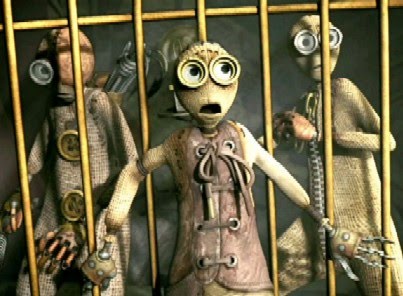
The personality in these faces is astounding.
Putting such character into burlap bags with lenses has me standing in awe of this level of artistry.
The way that 5 looks at you with this noble and terrified and courageous look shows the mark of an incredibly gifted and rare artist who understands the psychology behind aesthetics.
The nature of the beast is intriguing.
 There’s this kind of symbolism when 1 sacrifices himself for the good of the collective and allows the machine to absorb him.
I don’t know if this was a spiritual or political statement or both, but it was clear without being too obvious.
And that is a fine line.
 I have not cried since the 4th grade. I remember it very well. But every once in a while, a moment in a film will get me and I realize that if I were capable of tears, I’d be crying my eyes out.
“Pan’s Labyrinth” is the most recent example that comes to mind. But when one of these burlap characters perished, my heart just absolutely broke. I was crushed.
 There is a very good reason why each of the burlaps, or whatever we’ll call these little guys, have their own solitary dominant trait.
To wax on about these would mean spoiling a couple of key revelations that come at the end of the film. And I know that just pisses some people off.
Suffice it to say that the creator of these 9 survivors had to have been both shaman and scientist in equal parts.

“9” has gotten a lot of mediocre reviews and that doesn’t really surprise me. It’s not an obvious film and most film critics just aren’t that smart.
 “9” ranks up there with “Blade Runner,” “Minority Report” and “The Day the Earth Stood Still” in the realm of philosophical sci-fi.
Anybody who tells you “9” was all atmosphere and no substance simply wasn’t paying close enough attention.
I think my favorite visual might be 7’s bird-mask.

Visually, I was reminded of so many other films. And that’s not necessarily a slam, because the diversity of the sources "9" pulls its inspiration from is staggering. I saw bits of "Blade Runner," "2001," "Dead Space" (the video game), and "Robocop."
At one point I could almost hear Dick Jones’ ED-209 snarling in his robot voice, ‘you now have 20 seconds to comply!’ Oh, there’s no flashback like a murderous rampaging boardroom robot flashback.

And there’s a moment when 9 tells 5 not to look the machine in the eyes. It’s very reminiscent of “Marian, keep your eyes shut!”
And of course, there’s the unmistakable look of ‘The Nightmare Before Christmas."
The group of 9 look like a bunch of mini-Oogie-Boogies.
Now to the meat of the film.

I have always disagreed with the notion that books and films with Artificial Intelligence protagonists lack emotional poignancy.
Just in the medium of cinema alone, there’s the aforementioned "Blade Runner" and "Robocop" plus, there’s "A.I.," "Edward Scissorhands," "Frankenstein," "Pinocchio," "C-3PO & R2-D2" and "Battlestar Galactica."
There are people who just can’t get past the fact that these are man-made characters and therefore, they don’t matter or count.

Why not?
We matter, why?
Is it because we were made by God, in His image?
If angels had a hand in our creation, if God had their assistance, would that negate any meaning we have?
 So why would life that was created through man not be just as real, just as profound?
Life, by definition can not be artificial.
It’s odd that I just watched Duncan Jones’ "Moon" which could be a companion piece as it really tackles a lot of the same issues as "9" and "Blade Runner."
 Back to “9” specifically. At the beginning of the film these characters are more or less uniform. 5 is the exception.
 He is interesting and funny and more sympathetic than your average cowardly sidekick.
9 also develops a kind of courage. He becomes a character that embodies kind of what the popular myth of Winston Churchill is.

He has that whole “evil must be stood up to” uncompromising belief that you can’t help but admire.
Another recent film I reviewed here recently, “Glorious 39” featured a couple of characters like that, played by David Tennant and Romola Garai respectively.
There’s this kind of bizarre beauty as they call out each others’ number like names and it gets more and more touching as the film progressing.  They start speaking the numbers with meaning and passion where at the start, the tone of voice when they would speak the number of the others, the purpose was only to identify.
The personality in these faces is astounding.
Putting such character into burlap bags with lenses has me standing in awe of this level of artistry.
The way that 5 looks at you with this noble and terrified and courageous look shows the mark of an incredibly gifted and rare artist who understands the psychology behind aesthetics.
The nature of the beast is intriguing.
There’s this kind of symbolism when 1 sacrifices himself for the good of the collective and allows the machine to absorb him.I don’t know if this was a spiritual or political statement or both, but it was clear without being too obvious.
And that is a fine line.
 I have not cried since the 4th grade. I remember it very well. But every once in a while, a moment in a film will get me and I realize that if I were capable of tears, I’d be crying my eyes out.
 “Pan’s Labyrinth” is the most recent example that comes to mind. But when one of these burlap characters perished, my heart just absolutely broke. I was crushed.
 There is a very good reason why each of the burlaps, or whatever we’ll call these little guys, have their own solitary dominant trait.
To wax on about these would mean spoiling a couple of key revelations that come at the end of the film. And I know that just pisses some people off.
Suffice it to say that the creator of these 9 survivors had to have been both shaman and scientist in equal parts.
“9” has gotten a lot of mediocre reviews and that doesn’t really surprise me. It’s not an obvious film and most film critics just aren’t that smart.
 “9” ranks up there with “Blade Runner,” “Minority Report” and “The Day the Earth Stood Still” in the realm of philosophical sci-fi.
Anybody who tells you “9” was all atmosphere and no substance simply wasn’t paying close enough attention.
Monday, May 17, 2010
Invictus - Clint Eastwood (2009)
“Invictus,” Clint Eastwood’s story of how newly elected South African President Nelson Mandela used his country’s rugby team as an instrument of reconciliation, has its share of flaws, but in the end it’s inspiring in its own way.
 If you’re generally turned off by sports movies, you don’t need to worry. The focus of the film is Nelson Mandela’s determination to bring black and white South Africa together. The use of Rugby as the symbol for that fight is incidental.
As the film opens, we are given a brief, cliff-notes rundown of the events leading up to Mandela’s Presidency. We’re shown his release from prison, his role in staving off a civil war and his inauguration.
 If you’re generally turned off by sports movies, you don’t need to worry. The focus of the film is Nelson Mandela’s determination to bring black and white South Africa together. The use of Rugby as the symbol for that fight is incidental.
As the film opens, we are given a brief, cliff-notes rundown of the events leading up to Mandela’s Presidency. We’re shown his release from prison, his role in staving off a civil war and his inauguration.
To the shock and anger of many who put him in office, Mandela focuses on healing his country and moving forward rather than punishing his oppressors.

This determined reconciliation includes the sport of rugby, primarily supported by the country’s white minority. With so many in the country seeing the team as the last symbol of Apartheid, there is a push to shut the team down entirely.
Mandela, however, sees this as nothing but petty vengeance. He urges lawmakers to keep the team, including its colors of green and gold: the colors of Apartheid.

As the film moves forward, Mandela’s attempts to heal his country mirror the struggles of the rugby team as it tries to make itself fit to compete in the upcoming World Cup.
In the end, Mandela, his team and his country pull through in what we now know as one of the most profound changes in a country the world has ever seen.
Mandela is one of the great heroes of the 20th century and “Invictus” does his legacy justice.
It’s imperfections are easily overlooked. Yes, “Invictus” runs at least 20 minutes longer than it should and no, Matt Damon did not deserve his Best Supporting Actor nomination.
But in the end, the movie we are left with is a fitting tribute to the change one great leader can make, not only politically, but in the hearts of his countrymen. Morgan Freeman does a fantastic job of making Nelson Mandela more than just an historical icon.

While Eastwood’s film doesn’t match up to his other dramatic efforts of the decade like “Mystic River” or “Million Dollar Baby,” but “Invictus” is well worth the rental.
The Messenger – Oren Moverman (2009)
“The Messenger” follows Staff Sgt. William Montgomery, a wounded vet, fresh from Iraq whose new commission is to notify the next of kin when a soldier is killed overseas. When his commanding officer, Col. Dorsett played by the criminally underused Eamonn Walker, tells him that he will be spending the last three months of his enlistment on this, it’s plain that the Sergeant does not want this job. But as the Colonel tells him, being on a notification team is as much an honor as serving in combat. 
“This mission is not simply important,” explains Col. Dorsett. “It is sacred.”
It’s hard to say at first whether Sgt. Montgomery is insulted or intimidated by his new orders. I suspect it’s both. But he insists that he’s not the right man for the job because he knows nothing about grief counseling and doesn’t even believe in God.
That’s when Capt. Tony Stone, chimes in. Stone is played by Woody Harrelson who got an Oscar nod for this role.
“We’re just there for notification,” he simply tells the Sergeant. “Not God, not Heaven.”
As Capt. Stone spells out the rules and procedure for making the notifications, we listen in a state somewhere between shock and horror at just how detached Stone is. The rules include always using the words “died” or “killed” as opposed to “passed away.”
 The primary rule is never touch the next of kin. Stone tells his new trainee, “You are representing the Secretary of the Army, not Will Montgomery. So in case you feel like offering a hug or something, don’t.”
The first notification shows us just how brutal this “sacred” mission is.
Through the course of the film, we see Sgt. Montgomery and Capt. Stone make 6 notifications. Every one plays out differently, but each is devastating in its own way.
Over the course of the film, the “Messengers” are slapped, spit on and called cowards.
When we first hear Capt. Stone’s rules for notifying the next of kin, they sound callous, but as the film progresses, we understand that his approach is kind in its own way because it’s quick and gets them out of the way fast so the mourning families whose hearts they have just broken can get the news quickly and cleanly. It’s like taking off a band-aid. It might seem gentle to pull it off slowly, but in truth, ripping it right off is less painful.
Capt. Stone wants to get out of the families’ way and make room for the people whose job it is to heal these wounds.
Of course, this is complicated when Sgt. Montgomery tells a woman, played by Academy Award Nominee Samantha Morton, one of our best character actors, that her husband was killed in Iraq, only to find himself drawn to her. A romance, of sorts, blossoms between the two. But the focus is not on their relationship as much as what it means for two people who are broken to come together.
Montgomery sees the new widow at the mall soon after, confronting two army recruiters who are talking two teenagers into enlisting. She’s in a fit of grief and rage as she yells at them, “There’s a sticker on my coffin that says, ‘remains un-viewable.’ Nice big tall boys like you, what’s left can fit inside a shoebox.”
“The Messenger” is a film about the psychological effects war leaves on our troops, their families and our country as a whole. It’s clear filmmaker Owen Moverman understands mental illness. When Montgomery tells Stone that he almost took his own life after the firefight that left him wounded, he understands that when people are suicidal, they are profoundly confused about their feelings.
Most people who are suicidal can’t logically deconstruct their own psyches. When Montgomery tells Stone why he wanted to kill himself, he says, “The whole ‘living’ thing just didn’t make sense anymore.”
“The Messenger” is the most powerful and engaging film yet to come out about the current wars in Afghanistan and Iraq.
“The Hurt Locker” may have gotten the Oscar, but if you really want to see the ugliness of war outside the battlefield, Moverman’s meditation on grief is a far superior film.

“This mission is not simply important,” explains Col. Dorsett. “It is sacred.”
It’s hard to say at first whether Sgt. Montgomery is insulted or intimidated by his new orders. I suspect it’s both. But he insists that he’s not the right man for the job because he knows nothing about grief counseling and doesn’t even believe in God.
That’s when Capt. Tony Stone, chimes in. Stone is played by Woody Harrelson who got an Oscar nod for this role.
“We’re just there for notification,” he simply tells the Sergeant. “Not God, not Heaven.”
As Capt. Stone spells out the rules and procedure for making the notifications, we listen in a state somewhere between shock and horror at just how detached Stone is. The rules include always using the words “died” or “killed” as opposed to “passed away.”
 The primary rule is never touch the next of kin. Stone tells his new trainee, “You are representing the Secretary of the Army, not Will Montgomery. So in case you feel like offering a hug or something, don’t.”
The first notification shows us just how brutal this “sacred” mission is.
Through the course of the film, we see Sgt. Montgomery and Capt. Stone make 6 notifications. Every one plays out differently, but each is devastating in its own way.
Over the course of the film, the “Messengers” are slapped, spit on and called cowards.
When we first hear Capt. Stone’s rules for notifying the next of kin, they sound callous, but as the film progresses, we understand that his approach is kind in its own way because it’s quick and gets them out of the way fast so the mourning families whose hearts they have just broken can get the news quickly and cleanly. It’s like taking off a band-aid. It might seem gentle to pull it off slowly, but in truth, ripping it right off is less painful.

Capt. Stone wants to get out of the families’ way and make room for the people whose job it is to heal these wounds.
Of course, this is complicated when Sgt. Montgomery tells a woman, played by Academy Award Nominee Samantha Morton, one of our best character actors, that her husband was killed in Iraq, only to find himself drawn to her. A romance, of sorts, blossoms between the two. But the focus is not on their relationship as much as what it means for two people who are broken to come together.
Montgomery sees the new widow at the mall soon after, confronting two army recruiters who are talking two teenagers into enlisting. She’s in a fit of grief and rage as she yells at them, “There’s a sticker on my coffin that says, ‘remains un-viewable.’ Nice big tall boys like you, what’s left can fit inside a shoebox.”
“The Messenger” is a film about the psychological effects war leaves on our troops, their families and our country as a whole. It’s clear filmmaker Owen Moverman understands mental illness. When Montgomery tells Stone that he almost took his own life after the firefight that left him wounded, he understands that when people are suicidal, they are profoundly confused about their feelings.
Most people who are suicidal can’t logically deconstruct their own psyches. When Montgomery tells Stone why he wanted to kill himself, he says, “The whole ‘living’ thing just didn’t make sense anymore.”
“The Messenger” is the most powerful and engaging film yet to come out about the current wars in Afghanistan and Iraq.
“The Hurt Locker” may have gotten the Oscar, but if you really want to see the ugliness of war outside the battlefield, Moverman’s meditation on grief is a far superior film.
Valentine's Day - Garry Marshall (2010)
Garry Marshall’s “Valentine’s Day” begs the question, “Can a film critic write a review of a movie he couldn’t even make it six minutes through?” Well, this will be a short review. 
In the opening sequences, we are treated to horrible acting, contrived emotions and dialogue that somehow manages to be stilted and sappy at the same time. I have a relatively high pain threshold, but I couldn’t even make it through the opening credits.
This is six minutes of my life I want back. Garry Marshall, I’ll take the six minutes any way you’d like to give it. You can come to my house and vacuum. I’m sure you can get the living room and at least one bedroom taken care of in six minutes. Or you can show up at work and give me a six-minute shoulder massage.
However you want to pay it back is fine, but Garry Marshall, you owe me six minutes.

In the opening sequences, we are treated to horrible acting, contrived emotions and dialogue that somehow manages to be stilted and sappy at the same time. I have a relatively high pain threshold, but I couldn’t even make it through the opening credits.
This is six minutes of my life I want back. Garry Marshall, I’ll take the six minutes any way you’d like to give it. You can come to my house and vacuum. I’m sure you can get the living room and at least one bedroom taken care of in six minutes. Or you can show up at work and give me a six-minute shoulder massage.
However you want to pay it back is fine, but Garry Marshall, you owe me six minutes.
Subscribe to:
Posts (Atom)