Showing posts with label animation. Show all posts

Saturday, October 27, 2012

"Chicken With Plums" - Marjane Satrapi and Vincent Paronnaud (2012)


"Chicken With Plums" is Marjane Satrapi and Vincent Paronnaud's follow-up to their 2007 animated masterpiece, "Persepolis."

The film tells the story of Nasser-Ali, a man whose violin breaks.  He can't find a suitable replacement, so he decides it's time to die.


This may not sound like the premise for a magical film full of wonder, but it is.

Toward the beginning of the film, we're treated to a montage of Nasser-Ali fantasizing about all the possible ways he could kill himself.


Each method is distasteful, so he crawls into bed to wait for death.

And that's where the adventure begins.
 
As Nasser-Ali lies in bed, willing himself to die, he reflects on his life.  The film is primarily a series of flashbacks showing how he came to this sorry state.

We see how he became a gifted musician and why he married a woman he never loved.

More importantly, we see the true reason for his death wish.

Too many art films focus on gorgeous visuals at the expense of its theme and characters.

"Chicken With Plums" is not one of them.  There is plenty beneath the surface.

Thursday, July 14, 2011

"Harry Potter & the Deathly Hallows: Part 2" - David Yates (2011)

I’ll break the suspense and just tell you right off the top the Harry Potter film franchise has ended on a fantastic note.


The film is paced perfectly. It makes perfect sense why the decision was made to split “Deathly Hallows” into two films. “Deathly Hallows: Part 2” is so different from its predecessor that it really is in an entirely different genre.

From the opening Warner Brothers’ logo, it’s clear “Harry Potter and the Deathly Hallows: Part 2” was storyboarded and shot with 3D technology in mind. I have never seen a film use 3D to express so much of its theme and emotions of its characters the way this one does.

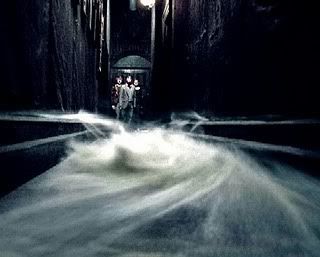
When “Deathly Hallows: Part 2” opens, dementors patrol the perimeters of Hogwarts, surrounding the school like smoke. Students trudge through the yard like inmates at a concentration camp or masses trapped in a “1984” dimension.
With those images, David Yates not only sets the tone of the film, but makes an immediate statement about the nature of totalitarianism: it’s simply the absence of joy.

The imagery of the Holocaust is so ingrained into our collective consciousness that films dealing with the most monstrous acts of the 20th century are emotionally devastating to begin with. It was an evil so incomprehensible, but so close and recent we can still taste it. Diagon Alley looks like the Warsaw ghetto.
But to say “Deathly Hallows: Part 2” uses these themes as an easy shortcut to elicit that tangible dread from us would be an injustice.

Once the tone of the film is set, the story kicks in and it stays in gear for the duration of the film. Daniel Radcliffe said in an interview that “Deathly Hallows: Part 2” starts as a heist film and evolves into a war movie.
That just about sums it up.

Without taking your hand and walking you through the story, there are just a few points to touch on.
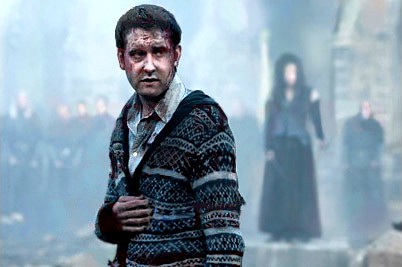
Ghosts of Goering, and Josef Mengele haunt the corridors of Hogwarts. When Harry, Ron and Hermione arrive at Hogwarts after months of chasing horcruxes, they are greeted by a visibly bruised and battered Neville Longbottom.

As an avid fan of the books, I adore Neville Longbottom’s story arc and one of my complaints about the Harry Potter films was that he has been largely ignored. “Deathly Hallows Part 2” finally gives Neville’s character the justice he deserves.

Other Hogwarts students from earlier films are there too, emaciated and beaten down, but ready to fight for the hope Harry brings with him when he arrives at the school.
Cho, Seamus, Lee Jordan and others are gaunt, but assemble for battle nevertheless.

What follows is very heavy on effects, but basic-looking. Again, the 3D technology serves the story and characters rather than just being there for the sake of itself. The ghost of Helena Ravenclaw is enraged when she talks of the evil Voldemort has used her family’s property for and it’s a mix of Kelly Macdonald’s skill as an actress and the effects that convey that fury.

Even the battle sequences, with a couple of flashy exceptions, abandon the bright colors coming from magic wands as wizards duel. The fighting here, magical as it is, is vicious, to the point of bestial.
Oddly enough, the 3D technology and animated effects serve the stripped down look well.

From the moment the battle starts, there are shots of dead students littering the background.
Rowling and Yates refuse to shy away from horrors like the mass murder of children, even in a mainstream film like this. They don’t flinch as Hogwarts burns and people Harry love die.

Draco learns, as does Jeffrey Beaumont in David Lynch’s “Blue Velvet,” that evil is not glamorous. When its allure is stripped away, it comes down to human suffering. Evil is appealing, but you don’t see how it hurts until you’re sucked in. I don’t think most people understand the statement Rowling is making about the fashion of evil, the glamorization of monsters in our society.

Again, the point here is more than helped along through the use of animated effects. With each horcrux destroyed, Voldemort’s appearance actually changes. He looks frailer each time one is finished off.
Ultimately, when we see the soul of the Great Lord Voldemort, we are faced with a creature that elicits pity and revulsion in equal parts.

If you’ve read the book, you know what I’m talking about and if you haven’t, you’ll know what I’m talking about when you see it. It’s an animated creature brought to pathetic life better than my imagination did itself when reading the book. By the way, managing to pull off something sadder and more grotesque than something that’s already in my head is quite an accomplishment.


The film climaxes with a dizzying one-on-one duel between Harry and Voldemort (it’s an incredibly nice touch when Harry simply calls his enemy “Tom”) and features a couple of deaths you must see in 3D.

It feels like I’m biting off more than I can chew, talking about all these different components in one post, but when you sit down and see the joyless Hogwarts castle for the first time, you’ll see exactly what I mean when I talk about 3D technology and animated effects fusing perfectly together with a film’s theme, tone and character development.

And Professor McGonagall is worth the price of admission alone, because watching an old lady just throw down is awesome.

Saturday, July 2, 2011

"Free Jimmy" - Christopher Nielsen (2006)


"Free Jimmy" is largely unknown, but thanks to the age of Nexflix, you have access to it.

I demand you see it at once.

That is all.


Enjoy my video review.

Love, your Resident Film Snob.

Tuesday, March 22, 2011

My Dog Tulip – Paul and Sandra Fierlinger (2010)


"My Dog Tulip" Photo Courtesy: New Yorker Films

“My Dog Tulip” is a milestone in animation. It is the first paperless, hand-drawn animated feature ever.


Of course that wouldn’t count for much if the movie wasn’t very good, but I’ll get to the analysis of the film’s content itself shortly.

Paul Fierlinger drew the film onto a digital tablet, using a stylus and Sandra Fierlinger filled in the images perfectly. She seems to know just the right colors to capture the right moods and just how much detail to use without giving too much away. They used a program called “TVPaint.”


Photo Courtesy: New Yorker Films


“Tulip” is based on J. R. Ackerley’s memoirs of how he finally found true friendship late in his life when he got his first dog, Tulip. Ackerley is voiced by Christopher Plummer.


I have not read the book in more than 10 years, but I remember laughing out loud a lot and as I watched the film, I kept remembering bits of the book I’d forgotten.


The film, like the book, is pretentious, funny and literate. So naturally, your Resident Film Snob loved it to pieces.

Ackerley whittles the most complex human emotions and experiences down into the basest of animal urges and what he comes out with in his book, is a remarkably wise record, not only of anecdotes, but proverbs.

For example, in the midst of his meditations on Tulip’s bathroom habits, Ackerley takes her through a cemetery. He seems to think the dead should be grateful that his dog is blessing them by using their resting place as a place to unleash her bowels.

After all, they ought to be grateful to be serving any purpose at all, shouldn’t they?


Tulip diddles on the dead. Photo Courtesy: New Yorker Films

The film’s style could not possibly fit the spirit of the book better. Paul and Sandra Fierlinger don’t draw “Tulip” with the realistic detail the Pixar generation has come to expect. After all, if it’s going to look so gall-darn realistic, why bother animating it? (That’s right, I said “gall-darn.” You’ll just have to pardon my French.)


Animation style dips several times into what the author sketched as he imagined his dog and sister home alone together. These sequences are simple doodles on paper.


Notice how, for some reason, as minimalist as his “style” is, he still takes the time to draw boobs on his sister. It’s either endearing or creepy. I guess it can be both. Hey, the guy wrote “The Prisoners of War,” so I’m not going to get all bent out of shape.


Photo Courtesy: New Yorker Films


And what he projects of human sexuality onto dogs is hysterical and emphasized through this simple doodling that he does, more than it ever could through more sophisticated animated effects.

This is important, since roughly half the movie involves Ackerley trying to get his beloved dog laid.


Photo Courtesy: New Yorker Films


Again, he goes about exploring sexuality by simplifying it through the eyes of his dog and again, the stripped down animated style is perfect here. It’s equally adorable and disconcerting how Tulip is drawn in a dress, like a lady of the night.


Photo Courtesy: New Yorker Films

It’s touching how he marvels at the way Tulip allows a very small dog to hump her even though Ackerley clearly thinks Tulip is far out of the mutt’s league.


Please don’t make the mistake of trying to watch this with your kids. “My Dog Tulip” is a wonderful cartoon for adults.


This film will be showing here in Kansas City at the Tivoli for at least another few days, so you really need to catch it while you can.

If you miss it, put it in your Netflix queue pronto.

My Dog Tulip – Paul and Sandra Fierlinger (2010)


Midwest Association of Professional Animators: My Dog Tulip – Paul and Sandra Fierlinger (2010): "'My Dog Tulip' Photo Courtesy: New Yorker Films “My Dog Tulip” is a milestone in animation. It is the first paperless, hand-drawn animate..."

Friday, March 18, 2011

Paul – Greg Mottola (2011)


“Paul” reunites “Shaun of the Dead’s” Simon Pegg and Nick Frost and teams them up with an animated alien voiced by Seth Rogan.

Fair warning, the film is filled with vulgarity and potty-mouthed humor.

But it's highly recommended.

And check out thetop10blog.com for a feature from your Resident Film Snob.

Sunday, November 21, 2010

David Yates Discusses Animated Sequence in "Harry Potter & the Deathly Hallows: Part 1"


Photo Courtesy: Warner Bros. Pictures
Here's an interview with David Yates about "Harry Potter and the Deathly Hallows: Part 1." In it, he talks about the animated sequence where the story of the three brothers and the origination of the Deathly Hallows is told.

That bit is toward the end, but the whole interview is worth a listen.


Tuesday, November 16, 2010

Harry Potter and the Deathly Hallows: Part 1 – David Yates (2010)

Photobucket

When I learned after “Goblet of Fire,” that some unknown television director named David Yates was going to take the helm of “Harry Potter and the Order of the Phoenix,” I wasn’t just apprehensive. I was disappointed. Annoyed even.


After seeing it, I was relieved. “Order” was the best Potter movie yet. Still, I wasn’t thrilled that Yates would be directing “Half-Blood Prince.” But Yates proved himself up to the task. When I walked out of the advance press screening for “Harry Potter and the Deathly Hallows: Part 1,” I was convinced that David Yates might be one of the finest filmmakers of this generation.


Part of me will be sorry to see the series go, but I’m truly excited to see what kind of career Yates has beyond the Harry Potter franchise. I’m dying to see what kind of movies he ends up making.


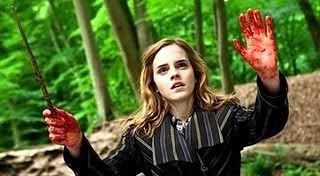
I went to the advance press screening of “Harry Potter and the Deathly Hallows: Part 1” this week and I can tell you I haven’t seen a film in a very long time that uses animation and special effects so brilliantly, yet sparingly. The animation is so unbelievably vivid, yet so subtle it’s barely noticeable at the same time. The reason for that is that the effects in “The Deathly Hallows” truly serve the story, characters and emotional impact of the film.


Almost every other movie a major studio cranks out takes the opposite approach where the story is there as a flimsy justification for showcasing whatever cool effects the audience wants to be wowed by. In “Harry Potter and the Deathly Hallows,” the story, character development and emotional impact of the film are already a solid foundation for everything else to dance on. Even without any effects or even magic, we’d be left with an exceptionally compelling drama with absorbing and conflicted characters. The animation and effects come in and serve the story instead of being the superfluous eye-candy audiences have become used to. It might sound like a contradiction to rejoice in how masterfully the animation was used in a film by saying that it wasn’t essential, but that’s just how carefully the effects are woven into this story.
Photobucket


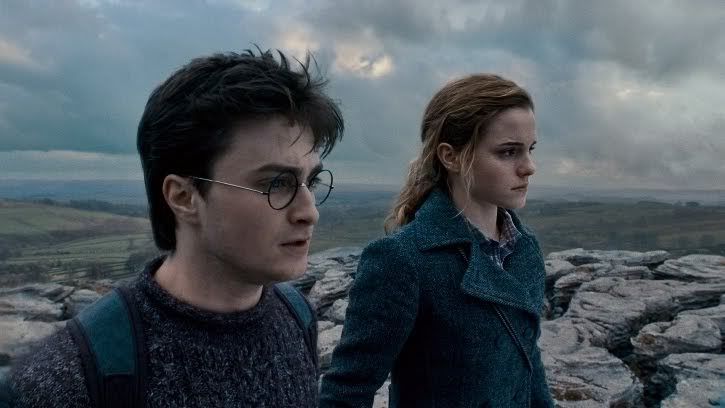
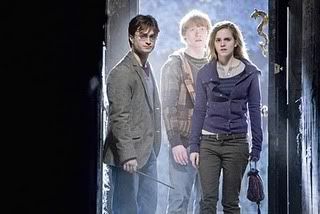
When Harry, Ron and Hermione interact, they do so on human terms. They are away from the visual opulence of Hogwarts and cinematographer Eduardo Serra keeps the look of the film as non-magical as possible, using the rugged look to remind us just how much these young wizards are out of their element.


This is Serra’s first Harry Potter film and it’s clear he was picked precisely because he’s not an effects-driven cinematographer. Serra is known for creating stunning pictures with very little backdrop, working with filmmakers like Claude Chabrol, Patrice Leconte, and Ian Softley. And that’s why, when the animation is brought in, it has so much power. When we see an effect, it’s for a reason, in “Deathly Hallows,” often to express the rage or despair of one of the characters.


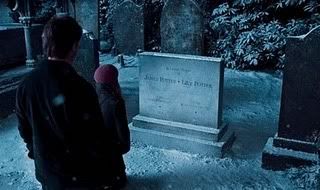
In another scene, Harry finds the graves of his parents and knees in front of their headstones. Hermione takes a place beside her friend, pulls her wand out and creates a beautiful wreath that’s now lying at their grave. It’s the perfect example of animation, and imagination being used to convey the most sincere emotion. It parallels the way in the wizarding world the way magic can be used to express the most profound sorrow, joy or comfort.


In another effects-driven, Harry and Ron destroy a Horcrux. (If you’re not a Potter fan and don’t know what that is, I’m not going to spend a lot of time explaining it to you. It’s an enchanted locket. There.) What comes out of the cursed object is Ron Weasley’s worst fears and deepest insecurities expressed through a wonderfully dismal and frightening animated sequence.


The real treat for aficionados of animation comes when it’s time for some good, old-fashioned back story. We hear the story of the three brothers who met Death and were given the “Deathly Hallows.” Hermione reads Harry and Ron the story from a children’s book while we’re treated to an animated short within the film that might be one of the most morbid, darkest little cartoons I’ve ever seen. It’s so wonderful and a perfect way to fill the audience in on the background of the story behind the legend of the very real magic they’re fighting against.


This cartoon alone is worth the price of admission, but really, the entire movie is simply wonderful. There is sadness and a joy in every look, touch and tone of voice when these three lifelong friends have any sort of exchange. The characters and the films have so many layers now, the storytelling is so rich that, visual effects aside, “Deathly Hallows” is just an incredible film.

Tuesday, May 18, 2010

9 – Shane Acker (2009)

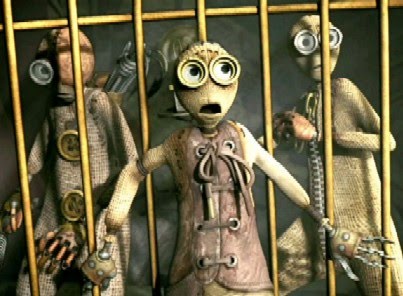
First, what this movie has going for it. It has atmosphere oozing out its eyeballs. The look and tone of the film is wonderful. Every frame, every shadow has this wonderful texture to it.


I think my favorite visual might be 7’s bird-mask.


Visually, I was reminded of so many other films. And that’s not necessarily a slam, because the diversity of the sources "9" pulls its inspiration from is staggering. I saw bits of "Blade Runner," "2001," "Dead Space" (the video game), and "Robocop."

At one point I could almost hear Dick Jones’ ED-209 snarling in his robot voice, ‘you now have 20 seconds to comply!’ Oh, there’s no flashback like a murderous rampaging boardroom robot flashback.

And there’s a moment when 9 tells 5 not to look the machine in the eyes. It’s very reminiscent of “Marian, keep your eyes shut!”
And of course, there’s the unmistakable look of ‘The Nightmare Before Christmas."


The group of 9 look like a bunch of mini-Oogie-Boogies.

Now to the meat of the film.


I have always disagreed with the notion that books and films with Artificial Intelligence protagonists lack emotional poignancy.

Just in the medium of cinema alone, there’s the aforementioned "Blade Runner" and "Robocop" plus, there’s "A.I.," "Edward Scissorhands," "Frankenstein," "Pinocchio," "C-3PO & R2-D2" and "Battlestar Galactica."

There are people who just can’t get past the fact that these are man-made characters and therefore, they don’t matter or count.


Why not?

We matter, why?


Is it because we were made by God, in His image?

If angels had a hand in our creation, if God had their assistance, would that negate any meaning we have?

So why would life that was created through man not be just as real, just as profound?

Life, by definition can not be artificial.

It’s odd that I just watched Duncan Jones’ "Moon" which could be a companion piece as it really tackles a lot of the same issues as "9" and "Blade Runner."

Back to “9” specifically. At the beginning of the film these characters are more or less uniform. 5 is the exception.

He is interesting and funny and more sympathetic than your average cowardly sidekick.


9 also develops a kind of courage. He becomes a character that embodies kind of what the popular myth of Winston Churchill is.


He has that whole “evil must be stood up to” uncompromising belief that you can’t help but admire.

Another recent film I reviewed here r
ecently, “Glorious 39” featured a couple of characters like that, played by David Tennant and Romola Garai respectively.


There’s this kind of bizarre beauty as they call out each others’ number like names and it gets more and more touching as the film progressing.

They start speaking the numbers with meaning and passion where at the start, the tone of voice when they would speak the number of the others, the purpose was only to identify.

The personality in these faces is astounding.

Putting such character into burlap bags with lenses has me standing in awe of this level of artistry.

The way that 5 looks at you with this noble and terrified and courageous look shows the mark of an incredibly gifted and rare artist who understands the psychology behind aesthetics.

The nature of the beast is intriguing.

There’s this kind of symbolism when 1 sacrifices himself for the good of the collective and allows the machine to absorb him.

I don’t know if this was a spiritual or political statement or both, but it was clear without being too obvious.

And that is a fine line.

I have not cried since the 4th grade. I remember it very well. But every once in a while, a moment in a film will get me and I realize that if I were capable of tears, I’d be crying my eyes out.


“Pan’s Labyrinth” is the most recent example that comes to mind. But when one of these burlap characters perished, my heart just absolutely broke. I was crushed.


There is a very good reason why each of the burlaps, or whatever we’ll call these little guys, have their own solitary dominant trait.

To wax on about these would mean spoiling a couple of key revelations that come at the end of the film. And I know that just pisses some people off.

Suffice it to say that the creator of these 9 survivors had to have been both shaman and scientist in equal parts.


“9” has gotten a lot of mediocre reviews and that doesn’t really surprise me. It’s not an obvious film and most film critics just aren’t that smart.

“9” ranks up there with “Blade Runner,” “Minority Report” and “The Day the Earth Stood Still” in the realm of philosophical sci-fi.

Anybody who tells you “9” was all atmosphere and no substance simply wasn’t paying close enough attention.