Showing posts with label 2009. Show all posts

Sunday, March 27, 2011

Cracks - Jordan Scott (2011)

Yes, I know "Cracks" made its debut at the 2009 Toronto Film Festival yet my title says "2011."

I've been going by U.S. Theatrical release dates. I decided to just pick a standard for the dates I use and stick with it for consistency's sake. So for the record, when there's a disparity between my dates and imdb.com's, that's why. It occurred to me that I have never explained that.

At any rate, "Cracks" was released in New York and L.A. on March 18, so it should be making its way here to Kansas City for a short run at some point this spring.

It has gotten mediocre reviews, but I thought it was a brilliant character study of a woman unable to tell narcissism from love.


If that sounds pretentious, there's a reason why the word "Snob" is in my title.

Here's my video review.

Monday, November 29, 2010

Nowhere Boy - Sam Taylor-Wood (2009)

John Lennon wasn’t just one of the most influential musicians of the last 50 years. He wrote words that became synonymous with peace.

His childhood was lonely, so how could a film about his life be so excruciatingly tedious to sit through?

Boring sad childhood.
Boring young lust.

Aaron Johnson, who plays Lennon, sleepwalks through the entire film and he looks like he’s just about as bored as all of us are.

Boring, boring, contrived conflicted repeated in somewhat different settings.

“We’re horrible authority figures.”

“Well, I’m a young, rebellious whippersnapper, so watch it.”

Kirsten Scott Thomas plays John Lennon’s aunt, who raised the lad. His mother doesn’t live far, and John goes over to visit a lot.

Of course, there’s a whole lot of angst going on. Mostly about "Why, oh why did mummy give me up?"

SPOILER: It’s because Lennon’s aunt convinced Social Services that she should have custody because she was a single mother and loose women make bad mothers.
END SPOILER

Lennon’s step-common-law-father is played by David Morrissey. I wondered to myself why they bothered casting someone like David Morrissey in such a throwaway, routine, stock role.

Then, I wondered why they were making this movie in the first place.

“Nowhere Boy” drags on for 45 minutes or so with no mercy killing in sight until finally John’s aunt buys him a guitar.

Never mind that it’s completely out of character for her.

Just thank God for the sake of the movie that she did so we can listen to the Quarrymen, Lennon’s pre-Beatles band, for a bit.


Along the way, on the music front, John meets a very young Paul McCartney, played by Thomas Sangster, best known for his stellar performance as the voice of “Ferb” from Disney’s animated series “Phineas and Ferb.”


Sadly, the music doesn’t last long and we’re back to the sad but monotonous life of the lad who would one day be John Lennon but for now, is just some kid living an angst-ridden life.

The rest of the movie follows the pattern of the first act.

More boring angst, followed by boring tragedy and then, young John is off to start a new band the screenwriters don’t mention the name of.

I assume they thought they were being clever.

If you're really bent on watching something about John Lennon or his music or anything related to the Beatles, watch "Hard Day's Night," "Yellow Submarine" or even Iain Softley's "Backbeat."

Better yet, just go and listen to "Imagine" or "Double Fantasy."

Or watch an episode of "Phineas and Ferb." It doesn't have anything to do with John Lennon, but it's not nearly the waste of your time "Nowhere Boy" is.

Monday, November 22, 2010

Grace – Paul Solet (2009)

Dear God, thank you for treating us to movies every once in a while that are just wrong in every way.“Grace” is Paul Solet’s feature film debut. Solet, isn’t someone you’ve heard of iunless you’re just the most obsessive horror movie fan in the universe, or maybe one of his friends or something.
He won “Fangoria Magazine’s” Best Short Horror Film of the Year Award in 2005 for his film, “Means to an End.”

It was amusing, but nothing earth-shattering. There was nothing in the film that would indicate he would go on to make such a wonderfully obscene and original first feature.

In a nutshell, “Grace” is about a cannibal baby.That’s right, this movie is about a baby that drinks blood. And of course, animal blood just won’t do. That would just turn into a short, boring movie really fast.

But “Grace” is wonderful and it is revolting. You have not seen breast feeding like this before.

But that’s not even the best part. Neither the blood-sucking baby nor the mother who supplies the infant with God’s yummy, red innards-nectar is the creepiest character in the movie.

The baby has a grandma who’s almost demonically insane. I mean, she is just a treat to watch. When she finds out she’s going to be a grandmother, she does some research and discovers that women can lactate past menopause if their nipples get sufficient stimulation.

Of course, the crazy grandma gets excited about this and starts letting grandpa into her sweater full of goodies for the first time in God knows how long, just in the hopes of being able to breastfeed her grand-baby. Which of course, is more unsettling than the baby who drinks blood.

Now that’s a level of insanity you have to work at. God doesn’t just give that kind of crazy away.

So what we have here is Solet weaving together a tapestry of people behaving in just the most unimaginable ways.


First, we have the baby who has to have breast blood instead of breast milk.

Then there’s the mother.

Let’s just say if you really like a sick thrill, like I do, it’s better for you go ahead and watch “Grace” then to have me explain how it all works here.

If you are the kind of person who’s just dying to have me describe how the mother gets Grace her blood, you’re probably the kind of person who's out there killing small animals, not the kind sitting at a computer, reading movie reviews.

Then you have the just unbelievably insane grandmother who’s determined to make herself start lactating again so she can feed her grand-baby, but oh my God, she has no idea what she’s getting into.

Add it all up and Solet serves up a recipe for a truly delightful 84-minute ick-fest.

If you like gross and you like “what is wrong with you lady” filmmaking, you really aren’t going to do a whole lot better than “Grace.”

Solet doesn’t come near the level of Cronenberg when it comes to examining just what our relationships to these bizarre things we call bodies are. But that is a high watermark.

Cronenberg will always be the master of this kind of film, but “Grace” is more than worth a look, nevertheless.

Friday, August 27, 2010

Ne te retourne pas (Don’t Look Back) – Marina de Van (2009)

When I started watching this film, I had no idea what it was going to be about.

To tell the truth, I have a soft spot for
French films, for some reason.

I have no idea what it is about that country, but their movies make sense to me.

Truffaut, Leconte,
Alain Resnais, Gela Babluani, Alexandre Bustillo, Gaspar Noe, I love 'em all.

French films are beautiful and horrific. They move, inspire and scare the Christ out of me all at the same time.

"Ne te retourne pas" is no exception. It does all of those things at once and it does them very slowly and subtly.

Aside from that, I had seen de Van’s 2002 freak-fest “Dans ma Peau” (In My Skin) and to this day, I’m the only person I have met in real life who liked it.

And who doesn’t want to spend 100 minutes or so watching Sophie Marceau? (Well, as it turns out, the better part of half that time, anyway.)

I vaguely had the idea that it was going to be some kind of thriller.

So imagine my delight and surprise when I found myself completely lost and confused as hell about 12 or 13 minutes into the movie.

The film centers around Jeanne, a French trade writer who finally wants to write fiction, specifically autobiographical fiction.

The problem is, she can’t remember anything before she was 8-years-old.

The other problem is that while her work as a professional writer is exceptional, her first attempt at fiction is terrible.

It’s tepid, self-aware, disassociated, overly-descriptive and trite.

Of course this is because memories of childhood are more than just facts told to Jeanne by her mother. The novel is cold because Jeanne never felt, touched or tasted a childhood. Poor Jeanne.

Before long, Jeanne’s mind starts playing tricks on her. Or is her family just messing with her?

Little things start to seem out of place, like the kitchen table, and s

he catches her husband and children ges

turing ominously to each other, exchanging conspiratorial hand signals.

Of course, at this point, we, the audience have no idea what's going on, but that’s okay

because neither do any of the characte

rs. Is Jeanne going crazy? Is it a brain tumor or a legion?

Is it Satan?

Actually, there’s nothing that suggests anything supernatural, but whenever there are endless, baseless theories as to what’s happening in a movie, I always like to throw Satan into the mix.

Before long, Jeanne’s loving husband is actually changing into another man and then Jeanne finds herself morphing.

The scene where we first see her with half of her own face and half of a new face surprised me by how effectively creepy it was.

It’s impressive how we’re about half an hour into the film and we have no reason to be frightened, but for some reason, I’m finding myself with a severe case of the willies.

Again, we still have absolutely no idea what is going on. And that's a very good thing because none of the characters do, either.

The rest of the film plays out with Jeanne’s mind swapping out her perception of realities to the point where her husband, mother, children and herself are different people.

Jeanne goes on a journey to find who her ‘true’ mother, self, husband, and her whole reality actually is.

By the time we get to the 'twist ending' which I won't give away just on the principle of not spoiling films, the plot is no longer the point. This isn't a film where the story matters.

The chain of events is incidental. What’s important is Jeanne’s broken mind.

Toward the beginning of the film, there’s a scene that shows her mother playing poker in an apartment with a handful of friends around a small table.

Later, when Jeanne visits her mother, she’s playing poker in an enormous, elegant penthouse, filled with affluent gamers, security guards and high stakes.

When Jeanne’s reality is altered, it’s disturbing, especially when the change is subtle.

For me, the most jolting moments were toward the building when she would catch her husband and children exchanging those subtle hand signals out of the corner of her eye or in a reflection or on a home video.

Of course, they had no idea what she was talking about and watching the film, I believed them.

They were truly her loving family and meant her no harm.

I was just as lost as Jeanne was and that was what made the film so psychologically gruesome.

Because Christ, do any of us really have any kind of grasp on anything?

Watch this movie. Buy this movie. It’s a masterpiece.

Along with John Hillcoat’s adaptation of “The Road,” this is the second film to make me realize I put out my top 10 of 2009 too soon.

I need to wait like a year before doing those.

And, in case any of you care, right now, I'm listening to:

Tuesday, May 18, 2010

9 – Shane Acker (2009)

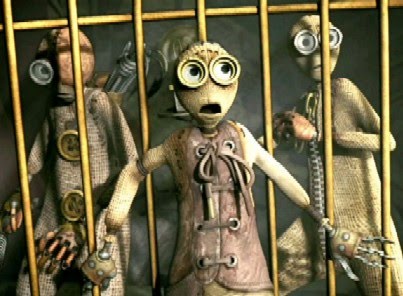
First, what this movie has going for it. It has atmosphere oozing out its eyeballs. The look and tone of the film is wonderful. Every frame, every shadow has this wonderful texture to it.


I think my favorite visual might be 7’s bird-mask.


Visually, I was reminded of so many other films. And that’s not necessarily a slam, because the diversity of the sources "9" pulls its inspiration from is staggering. I saw bits of "Blade Runner," "2001," "Dead Space" (the video game), and "Robocop."

At one point I could almost hear Dick Jones’ ED-209 snarling in his robot voice, ‘you now have 20 seconds to comply!’ Oh, there’s no flashback like a murderous rampaging boardroom robot flashback.

And there’s a moment when 9 tells 5 not to look the machine in the eyes. It’s very reminiscent of “Marian, keep your eyes shut!”
And of course, there’s the unmistakable look of ‘The Nightmare Before Christmas."


The group of 9 look like a bunch of mini-Oogie-Boogies.

Now to the meat of the film.


I have always disagreed with the notion that books and films with Artificial Intelligence protagonists lack emotional poignancy.

Just in the medium of cinema alone, there’s the aforementioned "Blade Runner" and "Robocop" plus, there’s "A.I.," "Edward Scissorhands," "Frankenstein," "Pinocchio," "C-3PO & R2-D2" and "Battlestar Galactica."

There are people who just can’t get past the fact that these are man-made characters and therefore, they don’t matter or count.


Why not?

We matter, why?


Is it because we were made by God, in His image?

If angels had a hand in our creation, if God had their assistance, would that negate any meaning we have?

So why would life that was created through man not be just as real, just as profound?

Life, by definition can not be artificial.

It’s odd that I just watched Duncan Jones’ "Moon" which could be a companion piece as it really tackles a lot of the same issues as "9" and "Blade Runner."

Back to “9” specifically. At the beginning of the film these characters are more or less uniform. 5 is the exception.

He is interesting and funny and more sympathetic than your average cowardly sidekick.


9 also develops a kind of courage. He becomes a character that embodies kind of what the popular myth of Winston Churchill is.


He has that whole “evil must be stood up to” uncompromising belief that you can’t help but admire.

Another recent film I reviewed here r
ecently, “Glorious 39” featured a couple of characters like that, played by David Tennant and Romola Garai respectively.


There’s this kind of bizarre beauty as they call out each others’ number like names and it gets more and more touching as the film progressing.

They start speaking the numbers with meaning and passion where at the start, the tone of voice when they would speak the number of the others, the purpose was only to identify.

The personality in these faces is astounding.

Putting such character into burlap bags with lenses has me standing in awe of this level of artistry.

The way that 5 looks at you with this noble and terrified and courageous look shows the mark of an incredibly gifted and rare artist who understands the psychology behind aesthetics.

The nature of the beast is intriguing.

There’s this kind of symbolism when 1 sacrifices himself for the good of the collective and allows the machine to absorb him.

I don’t know if this was a spiritual or political statement or both, but it was clear without being too obvious.

And that is a fine line.

I have not cried since the 4th grade. I remember it very well. But every once in a while, a moment in a film will get me and I realize that if I were capable of tears, I’d be crying my eyes out.


“Pan’s Labyrinth” is the most recent example that comes to mind. But when one of these burlap characters perished, my heart just absolutely broke. I was crushed.


There is a very good reason why each of the burlaps, or whatever we’ll call these little guys, have their own solitary dominant trait.

To wax on about these would mean spoiling a couple of key revelations that come at the end of the film. And I know that just pisses some people off.

Suffice it to say that the creator of these 9 survivors had to have been both shaman and scientist in equal parts.


“9” has gotten a lot of mediocre reviews and that doesn’t really surprise me. It’s not an obvious film and most film critics just aren’t that smart.

“9” ranks up there with “Blade Runner,” “Minority Report” and “The Day the Earth Stood Still” in the realm of philosophical sci-fi.

Anybody who tells you “9” was all atmosphere and no substance simply wasn’t paying close enough attention.

Monday, May 17, 2010

Invictus - Clint Eastwood (2009)

“Invictus,” Clint Eastwood’s story of how newly elected South African President Nelson Mandela used his country’s rugby team as an instrument of reconciliation, has its share of flaws, but in the end it’s inspiring in its own way.

If you’re generally turned off by sports movies, you don’t need to worry. The focus of the film is Nelson Mandela’s determination to bring black and white South Africa together. The use of Rugby as the symbol for that fight is incidental.

As the film opens, we are given a brief, cliff-notes rundown of the events leading up to Mandela’s Presidency. We’re shown his release from prison, his role in staving off a civil war and his inauguration.

To the shock and anger of many who put him in office, Mandela focuses on healing his country and moving forward rather than punishing his oppressors.

This determined reconciliation includes the sport of rugby, primarily supported by the country’s white minority. With so many in the country seeing the team as the last symbol of Apartheid, there is a push to shut the team down entirely.

Mandela, however, sees this as nothing but petty vengeance. He urges lawmakers to keep the team, including its colors of green and gold: the colors of Apartheid.

As the film moves forward, Mandela’s attempts to heal his country mirror the struggles of the rugby team as it tries to make itself fit to compete in the upcoming World Cup.

In the end, Mandela, his team and his country pull through in what we now know as one of the most profound changes in a country the world has ever seen.

Mandela is one of the great heroes of the 20th century and “Invictus” does his legacy justice.
It’s imperfections are easily overlooked. Yes, “Invictus” runs at least 20 minutes longer than it should and no, Matt Damon did not deserve his Best Supporting Actor nomination.

But in the end, the movie we are left with is a fitting tribute to the change one great leader can make, not only politically, but in the hearts of his countrymen. Morgan Freeman does a fantastic job of making Nelson Mandela more than just an historical icon.

While Eastwood’s film doesn’t match up to his other dramatic efforts of the decade like “Mystic River” or “Million Dollar Baby,” but “Invictus” is well worth the rental.

The Messenger – Oren Moverman (2009)

“The Messenger” follows Staff Sgt. William Montgomery, a wounded vet, fresh from Iraq whose new commission is to notify the next of kin when a soldier is killed overseas. When his commanding officer, Col. Dorsett played by the criminally underused Eamonn Walker, tells him that he will be spending the last three months of his enlistment on this, it’s plain that the Sergeant does not want this job. But as the Colonel tells him, being on a notification team is as much an honor as serving in combat.

“This mission is not simply important,” explains Col. Dorsett. “It is sacred.”

It’s hard to say at first whether Sgt. Montgomery is insulted or intimidated by his new orders. I suspect it’s both. But he insists that he’s not the right man for the job because he knows nothing about grief counseling and doesn’t even believe in God.
That’s when Capt. Tony Stone, chimes in. Stone is played by Woody Harrelson who got an Oscar nod for this role.

“We’re just there for notification,” he simply tells the Sergeant. “Not God, not Heaven.”

As Capt. Stone spells out the rules and procedure for making the notifications, we listen in a state somewhere between shock and horror at just how detached Stone is. The rules include always using the words “died” or “killed” as opposed to “passed away.”

The primary rule is never touch the next of kin. Stone tells his new trainee, “You are representing the Secretary of the Army, not Will Montgomery. So in case you feel like offering a hug or something, don’t.”

The first notification shows us just how brutal this “sacred” mission is.

Through the course of the film, we see Sgt. Montgomery and Capt. Stone make 6 notifications. Every one plays out differently, but each is devastating in its own way.
Over the course of the film, the “Messengers” are slapped, spit on and called cowards.

When we first hear Capt. Stone’s rules for notifying the next of kin, they sound callous, but as the film progresses, we understand that his approach is kind in its own way because it’s quick and gets them out of the way fast so the mourning families whose hearts they have just broken can get the news quickly and cleanly. It’s like taking off a band-aid. It might seem gentle to pull it off slowly, but in truth, ripping it right off is less painful.

Capt. Stone wants to get out of the families’ way and make room for the people whose job it is to heal these wounds.

Of course, this is complicated when Sgt. Montgomery tells a woman, played by Academy Award Nominee Samantha Morton, one of our best character actors, that her husband was killed in Iraq, only to find himself drawn to her. A romance, of sorts, blossoms between the two. But the focus is not on their relationship as much as what it means for two people who are broken to come together.

Montgomery sees the new widow at the mall soon after, confronting two army recruiters who are talking two teenagers into enlisting. She’s in a fit of grief and rage as she yells at them, “There’s a sticker on my coffin that says, ‘remains un-viewable.’ Nice big tall boys like you, what’s left can fit inside a shoebox.”
“The Messenger” is a film about the psychological effects war leaves on our troops, their families and our country as a whole. It’s clear filmmaker Owen Moverman understands mental illness. When Montgomery tells Stone that he almost took his own life after the firefight that left him wounded, he understands that when people are suicidal, they are profoundly confused about their feelings.

Most people who are suicidal can’t logically deconstruct their own psyches. When Montgomery tells Stone why he wanted to kill himself, he says, “The whole ‘living’ thing just didn’t make sense anymore.”
“The Messenger” is the most powerful and engaging film yet to come out about the current wars in Afghanistan and Iraq.

“The Hurt Locker” may have gotten the Oscar, but if you really want to see the ugliness of war outside the battlefield, Moverman’s meditation on grief is a far superior film.