Showing posts with label violence. Show all posts

Sunday, October 28, 2012

“Killer Joe” – William Friedkin (2012)


It is my sad duty to inform you that "Killer Joe" does not mark filmmaker William Friedkin's return to his former glory.


2006's underrated "Bug" notwithstanding, Friedkin hasn't done much worth our attention since "The French Connection" and "The Exorcist."

The director has floundered in mediocrity since the '70s, even making some flat-out bad films like "Jade" and "Rules of Engagement."
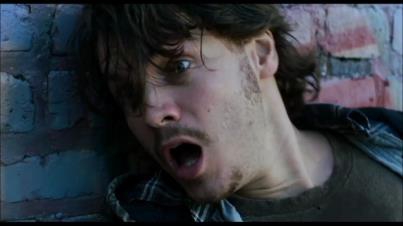
"Killer Joe" focuses on the Smith family.  When Chris gets himself in trouble with more debt than he can handle, the Smiths decide to hire a hit man to kill his mother so they can split her insurance money.

Enter the title character, a menacing cop who kills people on the side.

The problem is the Smiths can't pay Joe up front, so they work out a deal.  Joe gets full use of Dottie, the baby of the family, as a kind of retainer.

Inevitably, things go terribly wrong, but we don't really seem to care about the troubles heaped onto the Smiths.  Each of them is so detestable they frankly deserve to have Joe in their lives.   

The family's misfortunes are more than warranted.

I’m by no means someone who needs likable characters to enjoy a film, but try as it might, “Killer Joe” is no “Blue Velvet.”

There is one scene involving a piece of chicken and a battered Gina Gershon that brings to mind Dennis Hopper’s “MOMMY!” scene in “Blue Velvet.”  But Joe is no Frank Booth.

Frank was nightmarish and creepy, where Joe is unsettling at best.

Actually, the film's most menacing moments don't feature Joe at all, but Chris's debtor, Digger, played by character actor Marc Macaulay.  He only has one scene, but Macaulay delivers the film's best performance.  Frankly, I wanted to see more of Digger.

There are some melodramatic moments in the film, but not enough to sustain the thriller throughout.

The bottom line is, while "Killer Joe" is bold and at times tense, but it just isn't very good.

Sunday, September 30, 2012

"Looper" - Rian Johnson (2012)


At the very start of "Looper," we're treated to an assassination within a matter of seconds.  It's quite startling and goes a long way to establishing both the premise and tone of the film.

In the new sci-fi thriller, we're introduced to a future where time travel exists, but it's controlled by thugs.

 
Actually, in this future, time travel does not yet exist, but it will in the future-future.  That's right, hope you have your thinking caps on because the plot of this film is incredibly convoluted.


"Looper" takes place in 2044 in an unnamed town in Kansas.  A Looper is an assassin who kills people who are sent back in time to face their deaths.  That way, the bad guys in the future don't have any messy remains to dispose of.
Neat, huh?


And, of course, because the future criminal world doesn't like any loose ends, they have a habit of sending back old guys who used to be loopers to be executed by their younger selves.

And that's where our trouble starts.

Joseph Gordon Levitt plays Joe, an assassin who lives a charmed life filled with violence, drugs and sex, until he's expected to kill his future self, played by Bruce Willis.


The film also features Emily Blunt who plays a woman whose telekinetic son may or may not grow up to be a notorious mafia kingpin.

"Looper" reunites Levitt with director Rian Johnson, who collaborated on the sensitive but brutal high-school gumshoe film, "Brick," and this film has a similar, decidedly indie feel.

"Looper" is the best mainstream science fiction film since 1998's "Dark City."

It's brually violent and features a complicated, sordid and conflicted anti-hero.

Sunday, September 2, 2012

"The Cabin in the Woods" - Drew Goddard (2012)


If you only see one film this year about human sacrifice, for Jesus' sake, don't let it be "The Hunger Games."


"The Cabin in the Woods" is a simultaneously funny and scary horror film that comes out on blu-ray and DVD later this month.
 
 
Tension between city folk and hillbillies is just one of the fun elements of "The Cabin in the Woods."

The story is very familiar.  We follow a group of young people on a retreat into the woods where death and dismemberment awaits them.
 
The twist is the entire scenario is being controlled by a bunch of people in a lab.

Richard Jenkins and Bradley Whitford play the puppet masters who crack jokes like a sadistic Waldorf and Statler.


Seeing "The Cabin in the Woods" is the most fun I've had watching a movie in a very long time.

After years of a disturbing uptick in PG-13 horror movies, the horrific violence, profanity, nudity and sex in the film is more than welcome.

Saturday, September 1, 2012

In 'Lawless,' Nick Cave crafts a new murder ballad


CANNES, France (AP) -- Writing the Prohibition-era bootlegger crime film "Lawless" -- his second realized script and largest movie production yet -- taught Australian songwriter Nick Cave certain foundational lessons of Hollywood moviemaking.

   "I learned that it's a waste of time to graphically kill animals in scripts," Cave says, laughing. "It's going to hit the cutting room floor."

   The education and development of Nick Cave, screenwriter, continues with "Lawless," a tale of three bootlegging brothers (Shia LaBeouf, Tom Hardy, Jason Clarke) in rural 1920s Virginia. In adapting Matt Bondurant's novel, Cave was predictably moved to include scenes from the book of a pig's slaughter and a dead calf's birth, but had to settle for gangster gunplay and an ominous atmosphere alive with the constant threat of sudden brutality.

   The film marks Cave's continuing dalliance with screenwriting, "an extracurricular" activity, he calls it, along with novel and poetry writing. That's in addition to his "No. 1 job" as a musician and frontman of Nick Cave and the Bad Seeds and the currently dormant Grinderman.

   "I became a script writer with absolutely no idea of how to write a script whatsoever," says Cave, who also wrote the 2005 Australian outback Western, "The Proposition." "I still feel a bit of an outsider in that regard. If I can maintain that approach to screenwriting, it can continue to be enjoyable. But as soon as that's gone and I understand the process, I don't think I'll have much interest in writing scripts at all."

   Violence has been a rich vein for Cave since he emerged in the 1980s with the London-based punk outfit The Birthday Party. As a theatrical lyricist of spare fables, his gothic songs of death and mean men with a "red right hand" have often carried a murderous gravity and narrative bent.

   Like the bloody "Proposition," "Lawless" is another kind of murder ballad for Cave, one populated with colorful characters compelled by primal urges.

   "I don't know where that comes from except that it's a particular talent I have to write about that stuff," says Cave, a native of rural Victoria who now lives in Brighton, England, with his wife and twin sons. "Whether that's from being a country boy walking around the ranges with a shotgun as a child and all that sort of stuff, but that was very much what my childhood was like."

   Cave spoke in an interview first in May at the Cannes Film Festival, where "Lawless" competed for the Palm d'Or, and again by phone from Los Angeles, where he's recently recorded a new album with the Bad Seeds.

   Erudite and droll, Cave, the son of an English teacher and librarian, is an engaging subject whose dry wit captivated Cannes more than the star power of the film's cast, which also includes Guy Pearce and Jessica Chastain.

   LaBeouf attached himself to the script early on and stuck with the project through delays due to financing. He remained with it because of Cave's screenplay and the prospect of working with director John Hillcoat, a friend of Cave's who also directed "The Proposition."

   "When a man says to you, `I'm planning on making "Goodfellas" in the woods,' it's really hard to get away from that idea," says LaBeouf.

   Cave says that the larger size of "Lawless," which the Weinstein Co. is releasing in theaters Friday, "opened my eyes to how film is made," referring to the necessary compromising of a project with many interested parties.

   But screenwriting remains a fascinating process for Cave, who says it comes far more natural to him than songwriting. Despite the 54-year-old's decades in music, he calls songwriting torturous.

   "Songwriting is something where I have to go into a room on my own and battle it out and squeeze out these songs," says Cave. "It's like giving birth out of the tiniest of apertures. It's painful and it's kind of bloody, whereas writing scripts, I feel like a little boy."

   When Cave writes a script, he simultaneously is considering the score. For "Lawless," he wanted to avoid the Americana route, wary of competing with T-Bone Burnett's "O Brother, Where Art Thou?" soundtrack. Instead, he and Bad Seeds violinist Warren Ellis went for a "raw, punky feel."

   The score is thus full of countrified versions of more recent rock songs not typically done that way, most notably bluegrass legend Ralph Stanley singing the Velvet Underground tune "White Light/White Heat." Cave believes the song, which is about methamphetamine use, connects the film's criticism of Prohibition with contemporary anti-drug policy.

   Though Cave now finds himself an in-demand screenwriter, he says it reenergizes him for his "bread and butter" occupation.

   "Screenwriting is something I use to help keep the process of songwriting alive," he says. "If that's all I was doing, I would have dried up or gone into a real decline years ago with songwriting. I'm always coming back to songwriting. In fact, I'm always running back to songwriting screaming."

Sunday, August 26, 2012

"Lawless" - John Hillcoat (2012)

John Hillcoat waxes poetic about violence once again with his prohibition-era crime drama, "Lawless."
The film once again teams up Hillcoat and murder-music legend turned screenwriter Nick Cave.


The story centers around three bootlegging brothers, Jack, Forest and Howard.


Guy Pearce, who played the quietly ferocious Charlie Burns in Hillcoat's violent 2005 masterpiece, "The Proposition," shows up as Special Agent Charlie Rakes, the intensely creepy, sadistic dandy of a lawman intent on putting the Bondurants out of business.


Nick Cave's screenplay is dark with a fastidious attention to its characters.

Each character in the film carries a certain subtle menace.

Unfortunately, Shia LeBeouf and Jessica Chastain are in the cast, but Hillcoat does an admirable job of handling them and they manage to turn out relatively competent performances.

The body count isn't very high, but sparse at it is, each act of violence is sickening and brutal.

The violence in "Lawless" is glorious, as it should be.  The film is screaming and subdued at the same time, an unlikely mix that's become Hillcoat's haunting trademark.

If "The Road" and "The Proposition" weren't enough for Hillcoat to make his mark, "Lawless" goes a step further in establishing Hillcoat as one of the most important directors working today.

Friday, August 10, 2012

"96 Minutes" - Aimee Lagos (2012)

"96 Minutes" is a fairly impressive feature debut by newcomer Aimee Lagos. 
 
The premise of the film is a good person who does bad things is more of a monster than a straight-up bad guy.
 

The story follows Carley and Lena, two college students and Dre and Kevin, two high-school students. The characters are frantically trying to figure out what to do after Kevin shoots Lena in the face.
 

The narrative flips back and forth between the adrenaline-filled crisis sequence and the problems of the characters' everyday lives.
 

Lena is in love with a boy who treats her like something he dug out of his ear.


Carley is neglected by her father and anxious about starting law school.
 

Dre is a kid working hard to graduate and escape from street life.
 

And Kevin has trouble dealing with his foul-mouthed mom and her physically abusive boyfriend. But what Kevin really wants is to be a gangsta.
 

Eventually, the two timelines merge and we see exactly what led up to the shooting.
 

The film starts slow, but somewhere in the middle of the second act, the pacing catches up and we find ourselves involved in a fairly engrossing melodrama.
 

Dre makes mistake after mistake as he tries to dig himself and his friend out of a bad situation. The scenario makes for some very nice tension.


Ultimately, "96 Minutes" leaves us with little hope for mankind which puts it right in line with reality.

Thursday, July 19, 2012

"The Dark Knight Rises" - Christopher Nolan (2012)


Let's just get the question on everyone's minds out of the way.
 
No, "The Dark Knight Rises" is not as good as "The Dark Knight," but how many movies are?
 
The two films belong in different genres entirely.  "The Dark Knight Rises " is an action film on a massive scale while its predecessor was a brooding crime drama.
 
Having said that, there's no reason why anyone shouldn't enjoy the new Batman movie; it's spectacular.
 
The film opens up with an impressive action sequence that introduces us to a new brand of Batman villain.
 
It involves Bane allowing himself to be taken into custody and then promptly escaping by crashing a plane and killing a lot of people.
When one of Bane's henchmen willingly goes to his death, we realize we're not just dealing with criminals, but fanatics.
 
Tom Hardy plays Bane with a serviceable menace.
 
Bane bests Batman in a fight and it's surprisingly unsettling to see Batman defeated.
 
Showing all that rage and sadness with most of his face obscured is a tall order and hardy has Heath Ledger's enormous shoes to fill, but he manages to make it work beautifully.
 
As for the other villain, Anne Hathaway is simply fantastic as Catwoman.
At the start of the film, Hathaway plays her character with a convincing meekness with superb underlying intensity.
 
When she takes a sinister sharp turn, we completely believe her.
 
She establishes herself as someone who can more than take care of herself and her character evolves from there.
 
And just a side note the character actors featured in the film were chosen very well, from Burn Gorman to Matthew Modine.  (I was especially pleased to see "Torchwood's" Gorman.)

I'm afraid of saying too much in this review just because nobody wants to be spoiled.
 
Suffice it to say there are a couple of twists at the end.
 
I did not see one of them coming and the other you would have to be an idiot not to spot in the first act of the film.
 
So go, with my blessing.  Enjoy Batman in all his stylized glory.

Tuesday, June 26, 2012

The Flowers of War – Yimou Zhang (2012)


I can’t in good conscience recommend Yimou Zhang’s “The Flowers of War.”

The film follows John Miller, played by Christian Bale, a western mortician posing as a priest in 1937 Nanking.

We follow him as he tries to save a group of girls who are students at the convent and a group of prostitutes hiding in the church cellar.

I talked in my review of Agnieszka Holland’s “In Darkness” about poeticizing atrocities.  That’s exactly what “The Flowers of War” does.

At one point, during a brutal sequence when a character is raped and murdered, we’re given a beautiful cutaway to a spout of blood spraying from the victim’s chest.  It looks like a gorgeous fountain and I found the beauty with which it was filmed offensive.

And that’s a shame, because this film really does have a lot of things going for it.

“The Flowers of War” is gorgeously shot, but that’s a big part of the problem I had with it.  When danger comes, the music swells dramatically and we know somebody is going to die.

And the Japanese soldiers are directed terribly.  They don’t come off as menacing or maniacal, just cartoonish.

Christian Bale’s performance is more than adequate, though.  He takes his character from scoundrel to hero with complete believability.

Atsuro Watabe and Ni Ni should also get credit for subtle and nuanced performances, no easy feat in such a heavy handed film.

At any rate, if you’re looking for a film that takes a serious look at the atrocities people are capable of during war time, watch “In Darkness.”

Zhang hams it up in “The Flowers of War,” and when you’re dealing with such a delicate subject matter, it takes a steadier hand.  And "Shanghai Triad" is one of my favorite films, so imagine my disappointment.