Tuesday, November 9, 2010


Sunday, October 24, 2010
Hereafter – Clint Eastwood (2010)

Now that I’ve seen the film, I have to say anyone who found it gloomy probably just didn’t get it.
Clint Eastwood isn’t a filmmaker who shies away from death and “Hereafter” opens with a sequence that kicks you right in the face.
What’s disquieting about the scene isn’t its realism.
It’s how we follow Maria, a French journalist, played by “High Tension’s” Cecile de France, from the moment she realizes she’s in danger right up to her death.

As audiences, we’re used to seeing the carnage from a survivor’s point of view.
We watch other people go down, sometimes in horrific ways, with casual indifference.
As someone who unabashedly loves screen violence, I was surprised at how disturbed I was seeing this woman die.
We’re not used to seeing death from the victim’s point of view and this scene starts “Hereafter” on just the right note for Eastwood to ask his viewers to think very seriously about death.
When we experience death through the eyes of this woman, we know this isn’t going to be a thriller.
This film is going to be a meditation on the very nature of mortality and Eastwood takes the theme on just as seriously as he did with “Million Dollar Baby” and “Unforgiven.”
In the hands of a less capable storyteller, “Hereafter” might have been a contrived film. When I heard about the plot, it didn’t sound like something that would normally draw me in.
But after “
“Hereafter” centers around three people, all dealing with their brushes with death or grief in different ways.
First, there’s the story of Marie, the French journalist who died in the Tsunami and then came back to life, after seeing what lies after death.
She’s burning to tell the world what she’s seen and explore, as a writer, the scientific community’s studies on the subject of life after death.
Of course, this doesn’t do wonders for her career.
Then, there’s Marcus, a little boy in

He runs into all sorts of charlatans in a sadly funny sequence. We want to laugh at how ridiculous these people are, but then we see the disappointment on this kid’s face when they turn out to be frauds.
There’s one scene where Marcus goes into a group reading where a woman is on stage doing the John Edwards tricks. She goes across the crowd saying things like, “I’m feeling that someone here has lost someone,” and “I’m sensing a name that starts with ‘J.’”
This is a perfect juxtaposition to George, a rare psychic played by Matt Damon who actually is the real deal. We see this at the beginning of the film when he gives a reading to one of his brother’s clients as a favor.

George doesn’t mess around with any of this, “I’m sensing some vague who-the-hell-can-guess-what.” He knows exactly who he’s talking to and he hears them clearly.
Unfortunately, this ability is a burden. When George meets Melanie, a lovely young woman at a cooking class, played by Bryce Dallas Howard, there is instant chemistry between them.
Then, she finds out he has this gift and she asks him to do a reading. He all but begs her to let him off the hook, assuring her that once that happens, the chances their relationship will go anywhere will go down significantly.
Of course, she doesn’t listen and he gives in.
 And we’re not surprised to see that she doesn’t show up the next week for cooking class.

Clint Eastwood takes his time telling each story and treats each character with the care they deserve. When the paths of these three finally intersect, it doesn’t feel forced or artificial.
“Hereafter” has been marketed as a thriller, but it’s not.
It is an extremely gentle, if sometimes unsettling drama and it stands up with “Million Dollar Baby” and “Unforgiven” as Eastwood once again asks his audience to look death right in the face.

Because it’s being marketed as a genre picture, “Hereafter” will probably join “Gran Torino” as one of his recent films totally shut out as far as Oscar nods go and that’s a shame.
Just go see it.
Tuesday, May 18, 2010
9 – Shane Acker (2009)

I think my favorite visual might be 7’s bird-mask.

Visually, I was reminded of so many other films. And that’s not necessarily a slam, because the diversity of the sources "9" pulls its inspiration from is staggering. I saw bits of "Blade Runner," "2001," "Dead Space" (the video game), and "Robocop."
At one point I could almost hear Dick Jones’ ED-209 snarling in his robot voice, ‘you now have 20 seconds to comply!’ Oh, there’s no flashback like a murderous rampaging boardroom robot flashback.

And there’s a moment when 9 tells 5 not to look the machine in the eyes. It’s very reminiscent of “Marian, keep your eyes shut!”
And of course, there’s the unmistakable look of ‘The Nightmare Before Christmas."
The group of 9 look like a bunch of mini-Oogie-Boogies.
Now to the meat of the film.

I have always disagreed with the notion that books and films with Artificial Intelligence protagonists lack emotional poignancy.
Just in the medium of cinema alone, there’s the aforementioned "Blade Runner" and "Robocop" plus, there’s "A.I.," "Edward Scissorhands," "Frankenstein," "Pinocchio," "C-3PO & R2-D2" and "Battlestar Galactica."
There are people who just can’t get past the fact that these are man-made characters and therefore, they don’t matter or count.

Why not?
We matter, why?
Is it because we were made by God, in His image?
If angels had a hand in our creation, if God had their assistance, would that negate any meaning we have?
 So why would life that was created through man not be just as real, just as profound?
Life, by definition can not be artificial.
It’s odd that I just watched Duncan Jones’ "Moon" which could be a companion piece as it really tackles a lot of the same issues as "9" and "Blade Runner."
 Back to “9” specifically. At the beginning of the film these characters are more or less uniform. 5 is the exception.
He is interesting and funny and more sympathetic than your average cowardly sidekick.

9 also develops a kind of courage. He becomes a character that embodies kind of what the popular myth of Winston Churchill is.

He has that whole “evil must be stood up to” uncompromising belief that you can’t help but admire.
Another recent film I reviewed here recently, “Glorious 39” featured a couple of characters like that, played by David Tennant and Romola Garai respectively.
 There’s this kind of bizarre beauty as they call out each others’ number like names and it gets more and more touching as the film progressing.
 They start speaking the numbers with meaning and passion where at the start, the tone of voice when they would speak the number of the others, the purpose was only to identify.
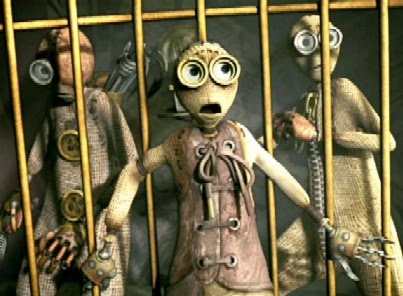
The personality in these faces is astounding.
Putting such character into burlap bags with lenses has me standing in awe of this level of artistry.
The way that 5 looks at you with this noble and terrified and courageous look shows the mark of an incredibly gifted and rare artist who understands the psychology behind aesthetics.
The nature of the beast is intriguing.
 There’s this kind of symbolism when 1 sacrifices himself for the good of the collective and allows the machine to absorb him.
I don’t know if this was a spiritual or political statement or both, but it was clear without being too obvious.
And that is a fine line.
 I have not cried since the 4th grade. I remember it very well. But every once in a while, a moment in a film will get me and I realize that if I were capable of tears, I’d be crying my eyes out.
“Pan’s Labyrinth” is the most recent example that comes to mind. But when one of these burlap characters perished, my heart just absolutely broke. I was crushed.
 There is a very good reason why each of the burlaps, or whatever we’ll call these little guys, have their own solitary dominant trait.
To wax on about these would mean spoiling a couple of key revelations that come at the end of the film. And I know that just pisses some people off.
Suffice it to say that the creator of these 9 survivors had to have been both shaman and scientist in equal parts.

“9” has gotten a lot of mediocre reviews and that doesn’t really surprise me. It’s not an obvious film and most film critics just aren’t that smart.
 “9” ranks up there with “Blade Runner,” “Minority Report” and “The Day the Earth Stood Still” in the realm of philosophical sci-fi.
Anybody who tells you “9” was all atmosphere and no substance simply wasn’t paying close enough attention.
Monday, May 10, 2010
Legion – Scott Stewart (2010)
 This movie has an enormous caveat and I’ll just give it to you up front. If you are not a horror movie fan, you will hate this movie.

Predictably, we are taken to a town that, if you’ve ever seen a horror movie in your life, we know is doomed. The name of the town is “Paradise Falls” and that is about as subtle as the film gets.
 One pleasant surprise was that at one point, the truck stop’s jukebox plays, “I Just Don’t Understand” by Ann Margaret. I thought I was the only fan of that song.
 As the first act starts, we meet our usual cast of characters that we know will be stuck together in the truck stop for the duration of the film.

Then there’s the bickering middle-aged couple and their smart-alek teen. Of course, we’re given the troubled young man who’s running from his own personal demons, We have the truck stop owner whose life is a miserable failure because, well, he’s a truck stop owner.


 And the action sequences when the truck-stop is under siege are fun enough to watch.
 But at the end of the day, “Legion” plays out like a traditional zombie movie with a twist.
Sunday, March 14, 2010
Das Weisse Band - Michael Haneke (2009)
 Let's just get this part out of the way. "Das Weisse Band" ("The White Ribbon") from
 I am still astonished that the Academy gave the prize to Juan Jose Campanella’s adequate but ultimately forgettable cold-case drama, "The Secret in Their Eyes" from
Both "Un Prophète" and "The Milk of Sorrow" were better than "Secret."
And here's the kicker. "The Secret in Their Eyes" was a very good film. It just shows how strong the Foreign Language Film category was this year.
Although how did "Sin Nombre" get overlooked?
"Das Weisse Band" wasn't just the best in the category of Foreign Language Film. It was a better film than any of the ten films nominated for Best Picture.
Michael Haneke constructs a disturbing tale of ritualistic punishment under the guise of either religion or responsible child-rearing.
The episodic nature of Ribbon works so beautifully. Each scene could easily stand on its own as an exceptionally strong short film.
And there is a mystery surrounding a series of either unfortunate or sinisterly planned accidents in a German village in the year or so leading up to World War I.
As the pastor, the schoolteacher, the doctor and the baron deal with the children of the small town in their alternately sadistic and confused ways, they learn that the Archduke of Austria has been assassinated in
It’s like the evil from the outside world is seeping into the town. Or is it the other way around?
Haneke has a long history of hypnotizing and unsettling us at the same time with films like "Funny Games" and "Cache."
When I watch one of his films, I am stunned that he can imagine a world where human beings are capable of such intense and profound evil, yet he presents it so casually.
When a child is ushered into a room by his parents and the door is closed behind them, that shot of the white door that we stay on for maybe 8 or 9 seconds has more tension and dread than anything in any horror film I've seen.
"Das Weisse Band" is Haneke's best film to date and as moving as Claudia Llosa’s meditation on illness and sexual abuse, "The Milk of Sorrow" from
 (Frankly, had Haneke lost to "Sorrow," or even "Un Prophète," I don’t think it would have bothered me.)
Haneke has long been admired for in the film community, both here and in
I, for one, certainly thought his haunting tale of ritualistic punishment and a serious of mysterious tragedies in a small town in pre-WWI  Alas and alack.

Antichrist - Lars von Trier (2009)
 This film elicited such a strong reaction from me that I found myself unwilling to censor myself when it came to language, so don't read this if you're not up to it.
Before I start, let me say that I would absolutely recommend that about 90% of you not see Lars von Trier's new masterpiece, Antichrist.
It is unbelievably hard to watch. If Antichrist were food, it would be Guatemalan insanity peppers.
Yes, it is brilliant and von Trier comes closer than ever to reaching the greatness of Breaking the Waves, (#28 on my top 100 list if you were wondering) but seriously, I would not wish this film on most people.
The vast majority of you will not appreciate or understand that and I do not mean that as an insult in any way.

On the contrary, I think that there must be something wrong with me the way I connected so deeply with Charlotte Gainsbourg's character, the figurative Antichrist for whom the film is named, and felt like I understood this movie so well.
Having said that, this is not only an unusually astute film, but also a very important one, socially and philosophically speaking, that the remaining 10% of you must seek out, no matter how hard it is going to be to find.
One more thing before I dig in.
Antichrist has been promoted as a horror film. Oh my God, it is so not.
It is horrifying, revolting even. It says something about a film that it made me look away a couple of times.

But it is not your standard horror fare as there is not a single thrill to be had.
There is also no paranormal element. The title, Antichrist, is metaphorical.
So here we go.
It would be very hard, if not impossible, to argue that Lars von Trier’s Breaking the Waves was not easily one of the best films to come out of the independent revolution of the 1990’s.
 It is equally impossible to talk about feminism in film without talking at length about von Trier's body of work.
He may be one of the most misunderstood filmmakers not only of our, but of any time.
I have heard von Trier called a misogynist, which is a laughable accusation.
I don't remember which critic it was, but someone actually called Breaking a "celebration of women's suffering."
Clearly, the suffering of women is the theme that ties his films together, but this misery seems to make him by turns weary, morose and livid.
I truly wonder if something horrible happened to a woman that he loved at some point early in his life for this to be so rooted in his cognition.
Breaking was a grizzly epic, a thesis on both the suffering and the heroism of women.

It was one of those rare film, I think there have only been six or seven of them, when I sat through the credits and several minutes of employees cleaning up popcorn after the showing because I was just too emotionally exhausted to move.
My heart still breaks every time I think of Bess’ willingness to forfeit her very soul trying to save someone she loves, losing her life in the process.
Seriously, try to wrap your mind around the gravity of Bess' actions.
She believes with all of her being that her actions will condemn her to an eternity in the fires of hell.
This belief is very real to her and this danger of burning forever is as real to her as any worldly, physical danger is to anyone.
 And she makes the sacrifice anyway to redeem this man she so desperately loves.
Bess is one of the most beautiful and selfless characters, not only in film, but in art.
Von Trier followed Breaking the Waves with Dancer in the Dark, another tribute to women’s proclivity to self-sacrifice.
Selma's child will not go blind even though it will cost Selma her life.
Again, a woman, suffering and selfless.

That was followed by Dogville, where the other side of the coin of the misery of women was wrath rather than nobility.
Von Trier's anger, like Grace's was more than understandable and even righteous up to a point.

These are three masterpieces that will stay with you forever once you’ve seen them and von Trier’s latest film, Antichrist is no exception.
To say that the opening sequence of Antichrist plays out like one of Lynch’s Obsession commercials would be accurate but flippant, thick and unfair.

We are treated, right out of the gate, to a black and white montage of Willem Dafoe making sweet slo-mo love to his special lady inter-cut with images of a toddler wandering around the apartment with an aria from Rinaldo by Handel playing in the background.
Von Trier isn't exactly going for subtle here. Character with a God complex accompanied by music by Handel, the guy who composed The Messiah.

The first thing that struck me was just how damn un-Dogma this movie was.
Then, we are jerked from this surreal opening straight into a beautifully shot, devastating tragedy.
The rest of the film continues to break pretty much every rule that von Trier set up for the Dogma movement, but you can still see that harsh realism under the surface, trying to claw its way out of every dream sequence, every camera trick, every metaphor, every art-house cliché.
This is probably the first time I have ever used the word cliché without meaning it as a rebuke.
Von Trier swings them like a hammer with deliberate purpose, contrasting them with the realism of the harsh, raw open-nerved emotions his characters are dealing with.

The dream sequences and artsy flashbacks cut into the horrific realism the way the musical numbers broke up the tragic evens of Dancer.
Willem Dafoe is a therapist whose wife is understandably falling apart after the death of their child.
Dafoe quickly finds fault with the care she is receiving from a colleague and breaks one of the rules he lives by as a therapist: don’t treat family.
Of course, it isn’t long before he finds himself breaking another rule: don’t have sex with your patient.
But give the guy a break.
He’s married to the woman.

Still. Turns out, fucking your patient is a bad idea, even if you’re married to her.
It is established almost immediately that this film is about payback.
The puzzle lies in figuring out which character has it coming.
You have the therapist, Willem Dafoe’s best performance since The Last Temptation of Christ, whose narcissism is so bountiful, whose God-complex is so vast that von Trier names the film after the character who defies him: Antichrist.
And just as we have tentatively decided who to indict, we realize, to our shame that nobody has it coming. We have spent a hundred minutes thinking about blame, as have the characters in this harsh and disturbing film.
But despite the events in the opening sequence, bad things do not happen because we are sexual creatures.
And suppressing our sexuality to the point of mutilation, sometimes figurative, sometimes tragically literal is never the answer.

Von Trier’s point here is this: Nature is not Satan’s church.
It sounds like a ridiculous notion, but it’s ingrained in our collective psyche nevertheless.
We think of human sexuality, the most natural thing in the world, as a breeding ground for all that is wicked.
We do in fact believe that nature is Satan’s church.
But we do not have it coming. We do not deserve it. We have to stop punishing ourselves.
It’s more than sad, it is appalling how people see God, but this is an accurate portrait of how western Christianity has set him up.

Like von Trier presents Willem Dafoe's therapist, Christians have painted God as a malicious being who talks about love, but whose sole purpose is actually to dole out unflinching, unforgiving and unjust punishment.
Too many see him as evangelical

That is how so many see God because that is what too many of our religious leaders have been insisting for centuries that he is.