We follow him as he tries to save a group of girls who are students at the convent and a group of prostitutes hiding in the church cellar.
Tuesday, June 26, 2012
The Flowers of War – Yimou Zhang (2012)
We follow him as he tries to save a group of girls who are students at the convent and a group of prostitutes hiding in the church cellar.
Sunday, June 24, 2012
"In Darkness" - Agnieszka Holland (2012)
| Merek Edelman 1919-2009 |

Edelman died in October of 2009 and it's wonderful to see he's remembered.
At any rate, the film was nominated this year for Best Foreign Language Film this year.
Here's my video review of the film.
Thursday, July 14, 2011
"Harry Potter & the Deathly Hallows: Part 2" - David Yates (2011)
The film is paced perfectly. It makes perfect sense why the decision was made to split “Deathly Hallows” into two films. “Deathly Hallows: Part 2” is so different from its predecessor that it really is in an entirely different genre.
From the opening Warner Brothers’ logo, it’s clear “Harry Potter and the Deathly Hallows: Part 2” was storyboarded and shot with 3D technology in mind. I have never seen a film use 3D to express so much of its theme and emotions of its characters the way this one does.
When “Deathly Hallows: Part 2” opens, dementors patrol the perimeters of Hogwarts, surrounding the school like smoke. Students trudge through the yard like inmates at a concentration camp or masses trapped in a “1984” dimension.
With those images, David Yates not only sets the tone of the film, but makes an immediate statement about the nature of totalitarianism: it’s simply the absence of joy.
The imagery of the Holocaust is so ingrained into our collective consciousness that films dealing with the most monstrous acts of the 20th century are emotionally devastating to begin with. It was an evil so incomprehensible, but so close and recent we can still taste it. Diagon Alley looks like the Warsaw ghetto.
But to say “Deathly Hallows: Part 2” uses these themes as an easy shortcut to elicit that tangible dread from us would be an injustice.
Once the tone of the film is set, the story kicks in and it stays in gear for the duration of the film. Daniel Radcliffe said in an interview that “Deathly Hallows: Part 2” starts as a heist film and evolves into a war movie.
That just about sums it up.
Without taking your hand and walking you through the story, there are just a few points to touch on.
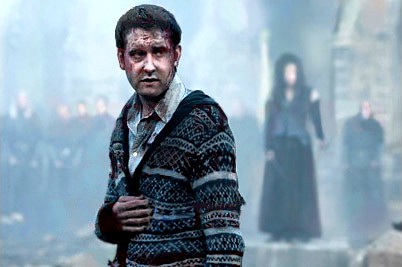
Ghosts of Goering, and Josef Mengele haunt the corridors of Hogwarts. When Harry, Ron and Hermione arrive at Hogwarts after months of chasing horcruxes, they are greeted by a visibly bruised and battered Neville Longbottom.As an avid fan of the books, I adore Neville Longbottom’s story arc and one of my complaints about the Harry Potter films was that he has been largely ignored. “Deathly Hallows Part 2” finally gives Neville’s character the justice he deserves.
Other Hogwarts students from earlier films are there too, emaciated and beaten down, but ready to fight for the hope Harry brings with him when he arrives at the school.
Cho, Seamus, Lee Jordan and others are gaunt, but assemble for battle nevertheless.
What follows is very heavy on effects, but basic-looking. Again, the 3D technology serves the story and characters rather than just being there for the sake of itself. The ghost of Helena Ravenclaw is enraged when she talks of the evil Voldemort has used her family’s property for and it’s a mix of Kelly Macdonald’s skill as an actress and the effects that convey that fury.
Even the battle sequences, with a couple of flashy exceptions, abandon the bright colors coming from magic wands as wizards duel. The fighting here, magical as it is, is vicious, to the point of bestial.
Oddly enough, the 3D technology and animated effects serve the stripped down look well.
From the moment the battle starts, there are shots of dead students littering the background.
Rowling and Yates refuse to shy away from horrors like the mass murder of children, even in a mainstream film like this. They don’t flinch as Hogwarts burns and people Harry love die.
Draco learns, as does Jeffrey Beaumont in David Lynch’s “Blue Velvet,” that evil is not glamorous. When its allure is stripped away, it comes down to human suffering. Evil is appealing, but you don’t see how it hurts until you’re sucked in. I don’t think most people understand the statement Rowling is making about the fashion of evil, the glamorization of monsters in our society.
Again, the point here is more than helped along through the use of animated effects. With each horcrux destroyed, Voldemort’s appearance actually changes. He looks frailer each time one is finished off.
Ultimately, when we see the soul of the Great Lord Voldemort, we are faced with a creature that elicits pity and revulsion in equal parts.
If you’ve read the book, you know what I’m talking about and if you haven’t, you’ll know what I’m talking about when you see it. It’s an animated creature brought to pathetic life better than my imagination did itself when reading the book. By the way, managing to pull off something sadder and more grotesque than something that’s already in my head is quite an accomplishment.
The film climaxes with a dizzying one-on-one duel between Harry and Voldemort (it’s an incredibly nice touch when Harry simply calls his enemy “Tom”) and features a couple of deaths you must see in 3D.
It feels like I’m biting off more than I can chew, talking about all these different components in one post, but when you sit down and see the joyless Hogwarts castle for the first time, you’ll see exactly what I mean when I talk about 3D technology and animated effects fusing perfectly together with a film’s theme, tone and character development.
And Professor McGonagall is worth the price of admission alone, because watching an old lady just throw down is awesome.
Sunday, May 29, 2011
"Incendies" - Denis Villeneuve (2011)
The film opens this Friday in Kansas City and everybody needs to see it.This film is devastating and brilliant.
It's the story of a brother and sister who are each given an envelope when their mother dies.
One is a letter to a brother neither of them knew existed and the other is for their father who they both thought was dead.
The story unwraps at a perfect pace as Jeanne and Simon head to the Middle East to solve the mysteries they've been handed.
This is how their mother's story is told and it unfolds with brutality.

Revenge, war, violence and sadism don't just mark the landscape of the region, they marked this woman's life.
The plot has a couple twists, but they aren't just there for the sake of having a twist.
I'm afraid to say much more except see this when it opens this weekend.
"Incendies" wasn't the best film nominated for Best Foreign Language at the Oscars this year. That distinction still goes to "Dogtooth."
But it's pretty damn brilliant.
Tuesday, May 18, 2010
9 – Shane Acker (2009)

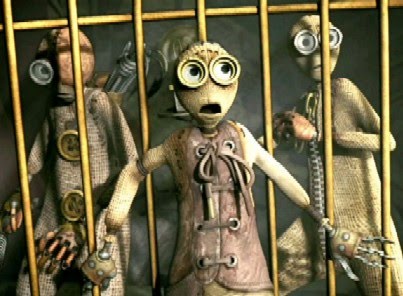
I think my favorite visual might be 7’s bird-mask.

Visually, I was reminded of so many other films. And that’s not necessarily a slam, because the diversity of the sources "9" pulls its inspiration from is staggering. I saw bits of "Blade Runner," "2001," "Dead Space" (the video game), and "Robocop."
At one point I could almost hear Dick Jones’ ED-209 snarling in his robot voice, ‘you now have 20 seconds to comply!’ Oh, there’s no flashback like a murderous rampaging boardroom robot flashback.

And there’s a moment when 9 tells 5 not to look the machine in the eyes. It’s very reminiscent of “Marian, keep your eyes shut!”
And of course, there’s the unmistakable look of ‘The Nightmare Before Christmas."
The group of 9 look like a bunch of mini-Oogie-Boogies.
Now to the meat of the film.

I have always disagreed with the notion that books and films with Artificial Intelligence protagonists lack emotional poignancy.
Just in the medium of cinema alone, there’s the aforementioned "Blade Runner" and "Robocop" plus, there’s "A.I.," "Edward Scissorhands," "Frankenstein," "Pinocchio," "C-3PO & R2-D2" and "Battlestar Galactica."
There are people who just can’t get past the fact that these are man-made characters and therefore, they don’t matter or count.

Why not?
We matter, why?
Is it because we were made by God, in His image?
If angels had a hand in our creation, if God had their assistance, would that negate any meaning we have?
So why would life that was created through man not be just as real, just as profound?Life, by definition can not be artificial.
It’s odd that I just watched Duncan Jones’ "Moon" which could be a companion piece as it really tackles a lot of the same issues as "9" and "Blade Runner."
Back to “9” specifically. At the beginning of the film these characters are more or less uniform. 5 is the exception. He is interesting and funny and more sympathetic than your average cowardly sidekick.

9 also develops a kind of courage. He becomes a character that embodies kind of what the popular myth of Winston Churchill is.

He has that whole “evil must be stood up to” uncompromising belief that you can’t help but admire.
Another recent film I reviewed here recently, “Glorious 39” featured a couple of characters like that, played by David Tennant and Romola Garai respectively.
There’s this kind of bizarre beauty as they call out each others’ number like names and it gets more and more touching as the film progressing.
They start speaking the numbers with meaning and passion where at the start, the tone of voice when they would speak the number of the others, the purpose was only to identify.The personality in these faces is astounding.
Putting such character into burlap bags with lenses has me standing in awe of this level of artistry.
The way that 5 looks at you with this noble and terrified and courageous look shows the mark of an incredibly gifted and rare artist who understands the psychology behind aesthetics.
The nature of the beast is intriguing.
There’s this kind of symbolism when 1 sacrifices himself for the good of the collective and allows the machine to absorb him.I don’t know if this was a spiritual or political statement or both, but it was clear without being too obvious.
And that is a fine line.
I have not cried since the 4th grade. I remember it very well. But every once in a while, a moment in a film will get me and I realize that if I were capable of tears, I’d be crying my eyes out. “Pan’s Labyrinth” is the most recent example that comes to mind. But when one of these burlap characters perished, my heart just absolutely broke. I was crushed.
There is a very good reason why each of the burlaps, or whatever we’ll call these little guys, have their own solitary dominant trait.To wax on about these would mean spoiling a couple of key revelations that come at the end of the film. And I know that just pisses some people off.
Suffice it to say that the creator of these 9 survivors had to have been both shaman and scientist in equal parts.

“9” has gotten a lot of mediocre reviews and that doesn’t really surprise me. It’s not an obvious film and most film critics just aren’t that smart.
“9” ranks up there with “Blade Runner,” “Minority Report” and “The Day the Earth Stood Still” in the realm of philosophical sci-fi.Anybody who tells you “9” was all atmosphere and no substance simply wasn’t paying close enough attention.
Monday, May 17, 2010
The Messenger – Oren Moverman (2009)

“This mission is not simply important,” explains Col. Dorsett. “It is sacred.”
It’s hard to say at first whether Sgt. Montgomery is insulted or intimidated by his new orders. I suspect it’s both. But he insists that he’s not the right man for the job because he knows nothing about grief counseling and doesn’t even believe in God.
That’s when Capt. Tony Stone, chimes in. Stone is played by Woody Harrelson who got an Oscar nod for this role.
“We’re just there for notification,” he simply tells the Sergeant. “Not God, not Heaven.”
As Capt. Stone spells out the rules and procedure for making the notifications, we listen in a state somewhere between shock and horror at just how detached Stone is. The rules include always using the words “died” or “killed” as opposed to “passed away.”
The primary rule is never touch the next of kin. Stone tells his new trainee, “You are representing the Secretary of the Army, not Will Montgomery. So in case you feel like offering a hug or something, don’t.”The first notification shows us just how brutal this “sacred” mission is.
Through the course of the film, we see Sgt. Montgomery and Capt. Stone make 6 notifications. Every one plays out differently, but each is devastating in its own way.

Over the course of the film, the “Messengers” are slapped, spit on and called cowards.
When we first hear Capt. Stone’s rules for notifying the next of kin, they sound callous, but as the film progresses, we understand that his approach is kind in its own way because it’s quick and gets them out of the way fast so the mourning families whose hearts they have just broken can get the news quickly and cleanly. It’s like taking off a band-aid. It might seem gentle to pull it off slowly, but in truth, ripping it right off is less painful.

Capt. Stone wants to get out of the families’ way and make room for the people whose job it is to heal these wounds.
Of course, this is complicated when Sgt. Montgomery tells a woman, played by Academy Award Nominee Samantha Morton, one of our best character actors, that her husband was killed in Iraq, only to find himself drawn to her. A romance, of sorts, blossoms between the two. But the focus is not on their relationship as much as what it means for two people who are broken to come together.
Montgomery sees the new widow at the mall soon after, confronting two army recruiters who are talking two teenagers into enlisting. She’s in a fit of grief and rage as she yells at them, “There’s a sticker on my coffin that says, ‘remains un-viewable.’ Nice big tall boys like you, what’s left can fit inside a shoebox.”

“The Messenger” is a film about the psychological effects war leaves on our troops, their families and our country as a whole. It’s clear filmmaker Owen Moverman understands mental illness. When Montgomery tells Stone that he almost took his own life after the firefight that left him wounded, he understands that when people are suicidal, they are profoundly confused about their feelings.
Most people who are suicidal can’t logically deconstruct their own psyches. When Montgomery tells Stone why he wanted to kill himself, he says, “The whole ‘living’ thing just didn’t make sense anymore.”

“The Messenger” is the most powerful and engaging film yet to come out about the current wars in Afghanistan and Iraq.
“The Hurt Locker” may have gotten the Oscar, but if you really want to see the ugliness of war outside the battlefield, Moverman’s meditation on grief is a far superior film.
Friday, April 9, 2010
Severe Clear - Kristian Fraga (2009)

Severe Clear, comprised of clips from a video journal shot by Lt. Mike Scotti has made the festival circuit and is about to see a limited U.S. theatrical release.
Whether it will come to Kansas City remains to be seen.
From the clips I've seen, Scotti and the film's director, Kristian Fraga showed a great deal of courage in releasing footage that shows every aspect of what I can only imagine what it must be like to be over there.

I saw desperation, grief, terror, courage, determination, horror, more grief, more terror and above all, desperation again.
My heart sank as Lt. Scotti told about how he and his squad fired on a car they thought was hostile, but turned out to be a man with his daughter.
He talks about killing and burying a little girl with her pink shoes. I felt anger, grief, hatred, pity and revulsion all within the span of about ten seconds. The rate, range and intensity of emotions was staggering.
And this was in a couple minutes worth of clips that I managed to see.That's my review of the couple of minutes. Severe Clear has made the festival circuit and from what I've heard, it's amazing.
I'm going to watch it as soon as possible and let you all know how it is.

Thursday, April 8, 2010
Glorious 39 – Stephen Poliakoff (2009)
I have to tell you, I was a bit disgruntled early into the film because, without spoiling anything for those of who will see this film, an actor I adore was gone in the first 23 minutes.
As for the film, it takes a while to find its feet. I was not sure for a while what kind of movie it was and actually, that is more than okay with me. To be honest, if I’m not sure if I’m going to be watching a love story or a political drama or a mystery or maybe even a ghost story, it enhances the entire experience and I went into this film completely cold.
The film opens with an ultimately dispensable bookmark. It’s an ominous introduction featuring Christopher Lee recalling the story of a girl who was lost long ago, before the war.
I don’t want to give too much away because I want everyone who reads this to seek this film out and watch it. As far as political thrillers go, you really can’t do any better than this one. It works in so many ways.
There’s a sequence that revolves around taking pets in to be euthanized. Putting the family cats down is incidental to the plot.
But the end of the story itself is perfect. The revelations are timed beautifully and never feel manufactured even for a moment.
So, fans of the Doctor, seek out this film because you miss David Tennant. That’s why I got it. But then find yourself absorbed in one of those rare films that works as a character study, a theme and a narrative.
Sunday, March 14, 2010
Das Weisse Band - Michael Haneke (2009)
Let's just get this part out of the way. "Das Weisse Band" ("The White Ribbon") from
I am still astonished that the Academy gave the prize to Juan Jose Campanella’s adequate but ultimately forgettable cold-case drama, "The Secret in Their Eyes" from
Both "Un Prophète" and "The Milk of Sorrow" were better than "Secret."
And here's the kicker. "The Secret in Their Eyes" was a very good film. It just shows how strong the Foreign Language Film category was this year.
Although how did "Sin Nombre" get overlooked?
"Das Weisse Band" wasn't just the best in the category of Foreign Language Film. It was a better film than any of the ten films nominated for Best Picture.
Michael Haneke constructs a disturbing tale of ritualistic punishment under the guise of either religion or responsible child-rearing.
The episodic nature of Ribbon works so beautifully. Each scene could easily stand on its own as an exceptionally strong short film.
And there is a mystery surrounding a series of either unfortunate or sinisterly planned accidents in a German village in the year or so leading up to World War I.
As the pastor, the schoolteacher, the doctor and the baron deal with the children of the small town in their alternately sadistic and confused ways, they learn that the Archduke of Austria has been assassinated in
It’s like the evil from the outside world is seeping into the town. Or is it the other way around?
Haneke has a long history of hypnotizing and unsettling us at the same time with films like "Funny Games" and "Cache."
When I watch one of his films, I am stunned that he can imagine a world where human beings are capable of such intense and profound evil, yet he presents it so casually.
When a child is ushered into a room by his parents and the door is closed behind them, that shot of the white door that we stay on for maybe 8 or 9 seconds has more tension and dread than anything in any horror film I've seen.
"Das Weisse Band" is Haneke's best film to date and as moving as Claudia Llosa’s meditation on illness and sexual abuse, "The Milk of Sorrow" from
(Frankly, had Haneke lost to "Sorrow," or even "Un Prophète," I don’t think it would have bothered me.)
Haneke has long been admired for in the film community, both here and in
I, for one, certainly thought his haunting tale of ritualistic punishment and a serious of mysterious tragedies in a small town in pre-WWI
Alas and alack.